Every once in a while, something about a new Shopify store seems worth emulating. So, you try to figure out what secret apps they are running.
The first reaction is usually the same: wait, that is it?
Six apps. Maybe seven. No bloated stack full of popup tools, overlapping plugins, or abandoned software nobody remembers installing.
Because brands doing $5M, $10M, or $20M a year tend to run leaner systems. Every app solves a specific operational problem: protecting margins, capturing customer data, reducing returns, or automating support work that normally eats half the day.
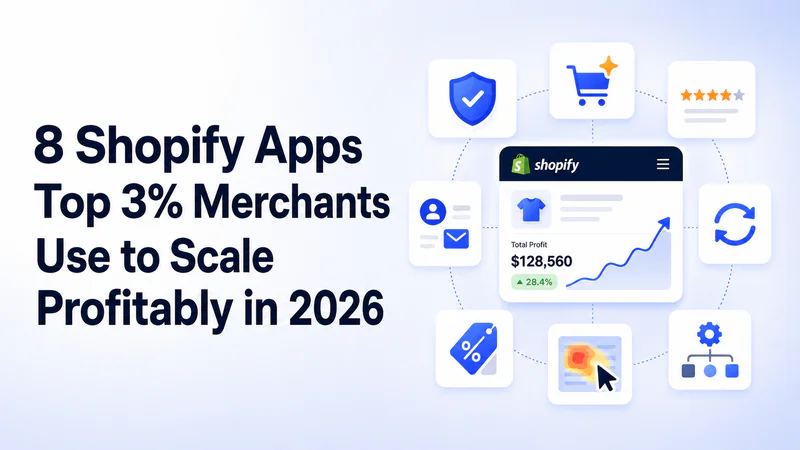
We kept seeing the same handful of tools appear across merchant stack breakdowns, agency playbooks for 7- and 8-figure brands, and Shopify App Store install data. So we pulled together the eight apps that surfaced most often, some well known, some surprisingly under the radar, and examined what they do to tackle the problems for the businesses using them.
Problem 1: Your margins are leaking and you can’t see where
As the quarter closes your net margin is... half of what it should be. But you optimized your ads relentlessly and tested pricing seventeen times. And ROAS? You checked it daily.
So where is your margin going exactly? Turns out, it’s going to refunding a customer whose package arrives damaged. Another order is so low-AOV that shipping and handling cost you more than you make. All of these compound- one leak at a time until your P&L is already broken.
And thinking “well, that's just e-commerce margins,” is not doing you any favors.
Here are two specific apps used by merchants that actually plug these holes:
1. SureBright Product Protection
We’ve all been trained to treat warranties with a pinch of salt and skepticism. Well, it’s time to change your mind.
A few years ago, BestBuy’s team divulged one of their most well-guarded secret- more than 50% of their profits came from offering warranties- at the right price, at the right time. Historically, offering warranties was a several months-long hectic process that could only be pursued by unicorns and decacorns.
Though with SureBright, several Enterprises and SMEs are now able to offer warranties in as little as 10-minutes. And yes several top-tier brands including Sennheiser, Hell’s Kitchen, and 500+ merchants signed-up for the opportunity.
Within just the home appliance industry, merchants of all sizes including Hell's Kitchen, Blackstone Grills, Verdi, SpeedyPress Irons have been seeing 23% attachment rates, 21% increased repeat purchases and 3.7 -> 4.1 customer ratings increase.
For a store selling products over $500 where purchase anxiety is real (electronics, furniture, outdoor gear, appliances, e-bikes), SureBright is a win-win for your margins.
2. Rebuy Engine
After appearing on Shark Tank, brain health and wellness brand MOSH faced the kind of problem most ecommerce brands die for: a flood of traffic and orders. But the challenge was making that spike last.
So they installed Rebuy.
Within 90 days, average order value on Rebuy-powered purchases was 19.1% higher. Post-purchase offers converted at 13.6%, sometimes crossing 16%, and Rebuy drove 16% of total sales during the period. MOSH’s finance lead reportedly Slacked the growth team asking, “What magic is this?” because revenue jumped without any changes to products, pricing, or ads.
By definition, Rebuy is an upsell tool that uses AI to personalise recommendations.
What separates it from similar tools is timing and personalization. Instead of static “related products,” it uses browsing and purchase behavior to surface relevant add-ons in the cart, on product pages, and especially after checkout, when the payment is already complete and customers can add another item with one click.
MOSH was not alone. With a 4.9 rating across 600+ Shopify App Store reviews, Rebuy is one of the major growth levers for brands that have already exhausted bundles, free shipping thresholds, and BNPL offers.
Problem 2: You have traffic, but no idea who your buyers actually are
You’re spending a good amount of budget to acquire traffic. Some visitors buy, most leave, and for the ones who convert, you get a shipping address and an email. That’s it. But the brands pulling ahead right now capture rich, first-party data at every touchpoint and feed it directly into the retention apps that drive repeat purchases.
3. Judge.me
The reason Judge.me keeps appearing in high-performing stacks is more specific than just popularity.
Products with reviews convert at 3.5x the rate of products without them. And most shoppers have been trained by Amazon to treat zero reviews the same way they’d treat a restaurant with an empty parking lot. The food might be excellent. But nobody’s risking walking in first.
A large part of the Shopify ecosystem treats reviews as a revenue stream through usage-based pricing, locked features, and extra fees for basic functionality. Judge.me became popular for the opposite reason: it gives stores a reliable review system without scaling costs alongside order volume.
Good Wash Day Towels is a haircare brand selling organic cotton towels in a category flooded with cheaper alternatives. Founder Carla Saull chose not to incentivize reviews or suppress negative feedback. Every review stayed public. Every reply came directly from her.
Over time, reviews became more than social proof. Customer feedback influenced new product sizes, product tweaks, and even the brand’s messaging around hair damage and self-care.
Judge.me handled the infrastructure underneath it: automated review requests, imported Etsy reviews into Shopify, and surfaced ratings across the storefront.
4. Klaviyo
Klaviyo functions as the central nervous system for many a store’s customer data. Every browse, cart abandonment, review, and support interaction feeds a single profile to trigger automated flows that feel personal.
Look at luxury fashion house Jenni Kayne. They focused heavily on hyper-segmentation to scale up email revenue without bombarding their list. By reducing email fatigue - dropping send frequencies from 3 per day down to 1 targeted send - they drove a 14.5% increase in total email revenue. Meanwhile, brands like POPFLEX utilize tactical, automated SMS triggers to triple their revenue during high-intent holiday sales windows.
But what if your customers aren’t even buying on Shopify?
This is where most omnichannel brands hit a massive data wall. You can track a digital click through Klaviyo perfectly, but what happens when a customer buys your product at a local boutique, a specialty distributor, or a major marketplace? How do you capture those customer details?
Dyrect bridges this exact offline gap. Instead of leaving those retail buyers anonymous, Dyrect allows you to place a custom QR code directly on your physical product packaging for OEM warranty registration. The customer scans it to protect their purchase, and you instantly capture their ownership data, pull them into your digital ecosystem, and clear a direct path for post-purchase upsells and flows.
Problem 3: Every return is an exit ramp instead of a second chance
The average online return rate hovers around 20%. In most cases, a customer ships an item back, a refund goes out, cash leaves the ecosystem, and the customer might disappear forever.
But high performing merchants use the following apps to turn every return into a retention opportunity:
5. ReturnGO
Instead of routing customers straight to a cash refund, ReturnGO’s self-service portal incentivizes product variant swaps and gift cards before refund even begins.
Brands like Underoutfit and Silk & Salt are a solid proof of how this works. By automatically offering a seamless exchange option (like swapping a Medium for a Large on the spot) or offering a bonus store credit, Underoutfit slashed their cash refund rate by 25.6%, while Silk & Salt successfully retained revenue on 24.1% of all processing returns. The money stays in your ecosystem, and the customer gets what they actually wanted.
6. Intelligems
Most conversion tools tell you what page layout gets more clicks. Intelligems tells you what actually makes you money.
Take CPG giant Momofuku. They integrated real-time discount and pricing tests to identify price elasticity before launching highly competitive holiday promotional events. Testing 5 entirely distinct checkout offer scenarios gave them the exact margin forecast needed to increase overall Black Friday profits by 28% by weeding out if lower discount thresholds or higher shipping lines would deter high-intent buyers.
Problem 4: Your support team is drowning in repetitive tasks
Is 60% to 70% of your helpdesk complaints volume a variation of “Where is my order?” or “How do I start a return?.” If yes, then you are effectively struggling with operational friction eating half of your team’s bandwidth. Use the following apps to manage this:
7. Lucky Orange
Before you can automate your support tickets, you have to understand why people are opening them. Usually, the answer is a design blind spot you’ve never noticed.
Stenbolaget, Sweden’s largest stone supplier used Lucky Orange’s live dynamic heatmaps and session recordings to isolate why mobile users were hitting roadblocks. They discovered shoppers were forced to jump back and forth just to change quantities in their cart, creating immense checkout friction.
Streamlining the product filtering options and engineering an editable cart quantity layout yielded an immediate 40% conversion rate boost and killed the repetitive support complaints at the source.
This kind of setup is best for teams fielding high volumes of repetitive inquiries or stores with healthy traffic but underperforming conversion rates.
8. Shopify Flow
This is the single biggest missed opportunity in the Shopify ecosystem. It's completely built-in, completely free for Advanced and Plus merchants, and relies on simple “if-then” logic to automate back-end manual workflows.
Operators leverage Flow to completely cut out error-prone tasks across fulfillment, fraud detection, and VIP customer filtering processes. For example, when high-value orders ($500+) clear checkout, Flow instantly tags the profile, triggers a premium tracking experience in Klaviyo, and sends a Slack ping to the warehouse manager for priority fulfillment.
Automating these backend tasks saves an average of 3 to 4 hours of administrative labor per week while driving an 8% to 12% increase in AOV simply through prioritized fulfillment speeds and proactive customer support tracking.
Flip side: What the top 3% merchants avoid
Knowing what to eliminate is just as important as knowing what to install. High-volume stacks are ruthlessly minimalist. And this is what they deliberately leave out:
Multiple popup tools: Running three different apps with competing behavioral triggers slows site speed and creates an instant bounce rate. Pick one reliable tool for capture, set tight conditions, and delete the rest.
Redundant tracking scripts: Google Analytics 4 plus a single heatmap provider (like Lucky Orange) is plenty. Stacking six different analytics plugins adds more and more seconds to your mobile page load time.
“Speed Boosting” apps: Paradoxically, many apps marketed as performance optimizers simply inject more heavy javascript into your theme, achieving the exact opposite of what they promise. Always run a clean before-and-after speed audit.
Conclusion
Adding more plugins doesn’t make your store more likely to succeed. In most cases, it can actually create more problems than it solves. And no, AI knows best can be a catastrophic assumption.
So, choose well, stay away from hyped-up apps- and keep focussing on apps that genuinely add value, not create more fluff.