
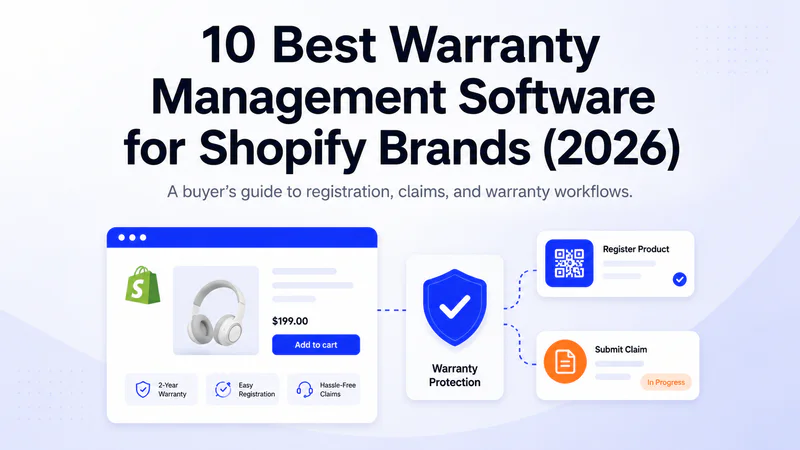
You might be looking for warranty management software for your Shopify store because something in your current setup is breaking down. Maybe it's a shared inbox full of claim requests with no clear owner. Maybe your team is copying order details into a spreadsheet to verify whether a customer is even within their warranty period. Maybe a customer emailed three times about a claim and no one has responded because no one knows whose job it is.
Whatever brought you here, the problem is the same: you're running warranty operations on tools that were never built for it. And at some point, that starts costing you in support hours, in customer trust, and in data you should be owning but aren't.
This guide compares 10 warranty management tools available for Shopify stores across six dimensions: registration reach, claims workflow depth, serial tracking, customer portal quality, integration ecosystem, and pricing. Each tool solves a different slice of the warranty problem. Some handle registration only. Some handle claims only. Some handle extended warranty sales. One covers the full lifecycle. The comparison below helps you match the right tool to where your warranty operations actually stand today.
TL;DR
For full warranty management (registration, claims, serial tracking, analytics, integrations): Dyrect. Free plan available, paid from $19/month.
For basic registration and claim intake: Propel ($9.95/month) or My Product Registration ($15/month). For serial number assignment at fulfillment: SeriaLogic ($9.99/month). For warranty terms display on product pages: Webkul ($9/month). For shipping protection revenue: Easy Shipping Protection (free). For extended warranty upsells: Warranly (free).
Each app solves a different part of the post-purchase workflow. The comparison below breaks down which features each tool covers and which it skips.
What Is Warranty Management App?

Warranty management apps handle the lifecycle of a product warranty: from the moment a customer registers their purchase, through coverage verification, to claim resolution. On Shopify, this matters because the platform tracks orders, payments, and inventory, but it has zero built-in support for warranty registration, coverage period tracking, claim workflows, or serial number validation.
That lifecycle has several moving parts. First, a customer needs a way to register their product and activate their warranty. Then the brand needs to store that registration against the right product, order, and customer record. When a claim comes in, the team needs a structured way to review it, validate it, assign it, and resolve it, whether the resolution is a repair, a replacement, a refund, or a rejection. Throughout all of this, both the customer and the support team need visibility into where things stand.
Without a dedicated app, all of this happens across email threads, spreadsheets, and disconnected Shopify order views. It works at low volume. It breaks down fast as you grow.
A complete warranty management app for Shopify brings all of that into one system. It gives customers a branded portal to register and track claims. It gives your team a dashboard to manage every open case. It connects to the products and orders already in your Shopify store so you're not re-entering data manually. And it gives you reporting that tells you which products are failing, how fast claims are being resolved, and where your registration rates are dropping off.
More advanced tools go further: capturing ownership data from buyers who purchased through retail, Amazon, or distributors, offering extended warranty upsells during registration, and connecting with helpdesks and CRM platforms so warranty data feeds into support, marketing, and customer success workflows.
Does Your Shopify Store Actually Need a Warranty Management App?

Not every store does, but most brands selling physical products will hit a point where email-based warranty handling stops working. Here are five signs you've already passed that point.
Your team spends time verifying warranty eligibility manually. When a claim comes in, someone has to find the original order, check the purchase date, confirm the product, and cross-reference it with your warranty terms. If that's taking more than a few minutes per claim, you need a system.
Customers don't know how to register or claim their warranty. If your current process is "email us at support@," you're creating friction that most customers won't bother with. The ones who do are often the most frustrated, which makes every interaction harder.
You have no idea who your customers are after the sale. If you sell through retail, marketplaces, or distributors, Shopify order data alone doesn't tell you who actually owns the product. You're flying blind on a significant chunk of your customer base.
Claims are falling through the cracks. Without a structured workflow, claim requests get buried in support queues. Customers follow up. Your team scrambles. The resolution is slow and the customer experience suffers.
You can't tell which products are failing or why. Warranty data is product intelligence. If you can't see which SKUs are generating the most claims, which defects are recurring, or which batches have quality problems, you're missing information that should be shaping your product decisions.
If any of these sound familiar, a dedicated warranty management app will pay for itself quickly, in reduced support overhead, higher customer satisfaction, and data you can actually act on.
What Warranty Management Is Worth to a Shopify Store
Most merchants evaluate warranty apps as a cost. The math works the other way.
For context, the average warranty administrator in the US earns between $23 and $26 per hour. Each manually processed warranty claim takes 25 to 45 minutes when you add up verification, eligibility checks, photo requests, internal routing, customer updates, and resolution.
At 100 claims per month, that adds up to 40 to 75 hours of staff time, roughly equivalent to a full-time employee handling warranty administration exclusively. Self-service warranty portals consistently reduce inbound support volume by 30 to 50 percent.
How Shopify Warranty Management App Works

The core workflow looks like this.
A customer buys a product. Either automatically through Shopify checkout sync or manually through a QR code, a registration page, or a branded form, they register that product and activate their warranty. They receive a digital warranty certificate by email. Their ownership record is stored in the system, linked to their product, serial number, and purchase details.
If something goes wrong, they return to the same portal, submit a claim, and upload any required documentation such as photos, proof of purchase, and a description of the issue. Your team receives a notification, reviews the claim against the warranty record, and assigns it to the right person. They track the resolution through to completion and keep the customer updated automatically.
In the background, the system is logging every registration, every claim, every resolution. That data populates analytics dashboards so you can see registration rates, claim volumes, product defect patterns, and team performance at a glance.
The better platforms extend this workflow in both directions. On the front end, they capture buyers who came from outside Shopify, through retail purchases, gifted products, and second-hand owners, through QR codes embedded in packaging or standalone registration pages. On the back end, they push data into your helpdesk, CRM, and email marketing tools so warranty activity connects to the rest of your customer relationship.
The better platforms extend this workflow in both directions. On the front end, they capture buyers who came from outside Shopify, through retail purchases, gifted products, and second-hand owners, through QR codes embedded in packaging or standalone registration pages.
On the back end, they push data into your helpdesk, CRM, and email marketing tools so warranty activity connects to the rest of your customer relationship. Some newer tools also add AI-powered claims triage, where the system analyzes submitted photos and descriptions to auto-verify coverage, detect potential fraud, and recommend resolution paths before a human reviews the case.
6 Criteria That Separate the Best Shopify Warranty Apps from the Rest

1. Registration Reach: Online, Offline, QR, and Beyond
Most warranty apps capture registrations from Shopify orders automatically. That's table stakes. What separates stronger tools is whether they can capture customers who didn't buy from your Shopify store.
If you sell through retail chains, Amazon, independent dealers, or pop-up events, a significant portion of your actual customers are invisible to Shopify. A warranty app that only syncs Shopify orders will miss all of them. The right solution offers QR code registration via product packaging, standalone branded registration pages accessible from any browser, and the ability to register offline purchases with a receipt or serial number.
This matters beyond the individual customer interaction. Every registration is a data point: name, email, product, location, purchase channel, and purchase date. For brands running email marketing, loyalty programs, or product feedback loops, that data is the foundation. Missing it because registration only works through Shopify checkout is a significant gap.
2. Claims Management Depth vs. Basic Form Intake
There is a real difference between an app that collects claim submissions and an app that manages claims end to end.
Basic claim intake means the customer fills out a form and the data lands in a dashboard. From there, someone on your team has to figure out what to do with it manually. There's no structured workflow, no assignment logic, no status tracking, and no automated customer communication.
Proper claims management means each claim has a status, an owner, a resolution type such as repair, replacement, refund, or rejection, and a communication trail. Customers can check their claim status without emailing you. Your team can see every open claim, filter by product or status, and action them without switching between tools. Automations handle the routine notifications so your team focuses on actual decisions.
For brands with any meaningful claim volume, the difference between these two approaches is significant in time saved and customer satisfaction delivered.
3. Customer Portal Quality and Self-Serve Experience
The customer portal is the part your buyers actually see. A poor portal experience, confusing navigation, clunky forms, and no claim status visibility, creates exactly the frustration a warranty program is supposed to avoid.
A good portal lets customers register a product in a few steps, see their active warranties, submit a claim without emailing support, and track that claim through to resolution. It should be branded to match your store, mobile-friendly, and accessible without requiring a customer account login that most buyers won't remember.
The portal is also a retention touchpoint. A customer who registers their product and has a positive warranty experience is far more likely to buy from you again. Brands that treat the portal as a transactional necessity rather than a brand moment miss the opportunity it creates.
4. Serial Number Tracking and Fraud Prevention
For brands selling electronics, tools, appliances, or any product where the serial number matters, serial tracking is not optional. It's how you confirm that the customer claiming a warranty actually owns the product, that the product is within its warranty period, and that the claim hasn't already been filed.
Apps with robust serial tracking let you import serial number lists, validate them at the point of registration, flag duplicates, and link each serial to a specific customer record. This prevents fraudulent claims, including customers claiming warranty on products they don't own, claims filed multiple times on the same unit, and registrations with fabricated purchase details.
Without serial validation, your warranty program is vulnerable to abuse. The cost of fraudulent claims adds up quickly in replacement stock, shipping, and team time.
5. Integration Ecosystem
A warranty app that lives in isolation creates work. Every time a claim comes in, someone has to check the warranty system and then open Gorgias, or Klaviyo, or HubSpot, and manually update the record or trigger the communication.
The best tools integrate directly with the platforms your team already uses. Helpdesk integrations with Zendesk and Gorgias mean warranty claims appear as support tickets. CRM integrations with HubSpot and Zoho mean customer ownership records flow into your contact database. Email platform integrations with Klaviyo and Mailchimp mean registration events can trigger post-purchase sequences.
These integrations aren't a nice-to-have for growing brands. They're what makes warranty data actionable rather than just stored.
6. Analytics, Not Just Records
Records tell you what happened. Analytics tell you what to do about it.
A warranty app with proper analytics lets you see which products generate the most claims, which defects are recurring, how fast your team resolves cases, and how registration rates vary across product lines and channels. That information shapes product development, quality control, support staffing, and customer communication strategy.
An app that only stores registrations and claims without surfacing insights is just a database. The tools that help growing brands improve over time are the ones that make warranty data visible and actionable.
7. Compliance and Regulatory Support
For Shopify brands selling physical products to EU consumers, a new regulatory requirement takes effect in September 2026. EU Regulation 2025/1960 requires online stores to display a standardized legal guarantee notice on product pages, and for products with a producer durability guarantee exceeding two years, the official GARAN label must appear in the customer's language.
Most warranty apps on Shopify do not address this. Brands selling across multiple EU markets need to evaluate whether their warranty tool handles compliance labeling or whether they need a separate solution for it. This criterion matters most for brands with meaningful EU revenue.
Self-Managed vs Third-Party Warranty: What Shopify Brands Should Know
There are two ways to run warranty on Shopify. The economics are very different.
Most growing Shopify brands start with third-party providers because setup is easy. As claim rates stay low and product prices stay above $50, self-managed programs generate 3x to 5x more margin. The trade-off: self-managed means your team handles every claim, and you carry the liability for replacements and repairs.
Dyrect is built for the self-managed model. You own the warranty, the claims process, the customer data, and the revenue.
10 Best Shopify Apps for Warranty Management in 2026
A quick comparison:
Best Warranty Shopify Apps: Feature Comparison
1. Dyrect — Complete Warranty Registration and Claims Management for Shopify Brands

Dyrect covers the full warranty management workflow from a single Shopify-connected dashboard: product registration (QR code, web form, and Shopify checkout sync), structured claims management with assignment and resolution tracking, serial number validation, a branded customer self-serve portal, analytics, and native integrations with Klaviyo, Gorgias, Zendesk, HubSpot, and Mailchimp.
Trusted by 350+ merchants and rated 5.0 on the Shopify App Store and 4.8 on G2, Dyrect is built for brands that sell across multiple channels and need warranty operations that match. The setup takes under 20 minutes. The platform scales from a brand doing its first hundred registrations to an operation managing thousands of claims across multiple product lines.
Best suited for: Mid-sized and growing Shopify brands selling physical products across multiple channels, including electronics, home goods, outdoor gear, wellness devices, and appliances, that want registration, claims, and customer data in one system.
Product Registration That Captures Every Buyer, Not Just Shopify Checkout
Most warranty apps register customers who bought through your Shopify store. Dyrect captures everyone else too.
Customers who bought from a retail partner, a marketplace, a pop-up event, or a distributor can register their product through a QR code embedded in your packaging, a branded registration page on your domain, or a custom form accessible from any device. They don't need to have placed a Shopify order to activate their warranty. They just need the product.
Every registration generates a structured data record: name, email, product, serial number, purchase date, and purchase channel. For Shopify brands running Klaviyo flows, HubSpot pipelines, or loyalty programs, that data is the starting point for every post-purchase relationship.
Ultraprolink described the shift plainly: "Before this platform our warranty registration and claim management used to be scattered across emails and spreadsheets. Now with Dyrect everything is in a single dashboard. Plus, the Shopify coupon integration has been a useful addition for driving registrations and repeat purchases."
Claims Management With Repair, Replacement, and Full Workflow Visibility
Dyrect's claims management goes well beyond form intake. When a customer submits a claim through the self-serve portal, it lands in the Dyrect dashboard with the full ownership record attached: product, serial number, purchase date, warranty status, and any previous interactions. Your team doesn't need to verify anything manually.
Each claim can be assigned to a team member, moved through a structured workflow, and resolved as a repair, replacement, refund, or rejection. Automated email notifications keep the customer informed at each stage without anyone on your team having to write a single message. Every resolution is logged, giving you a complete audit trail and a growing dataset on claim patterns over time.
The advanced plan includes repair workflow management, billing and invoicing, and service visibility features, making Dyrect usable for brands that run in-house service centers as well as those that outsource repairs.
DIGGS Pet noted: "The platform is easy to use and makes processing warranty tickets smooth and efficient. It's been a huge time-saver for our team, especially with the automated email notifications that keep our customers informed throughout the process."
Analytics, Integrations, and Revenue Built Into the Same Platform
Dyrect's built-in analytics dashboard gives you registration rates by product and channel, claim volumes, resolution times, and defect patterns over time. For product teams, this data shapes quality control decisions. For support teams, it identifies where to focus. For leadership, it converts warranty activity into business intelligence rather than just operational overhead.
On the integration side, Dyrect connects natively with Klaviyo, Mailchimp, HubSpot, Zendesk, Gorgias, and Zoho Desk. A registration event can trigger a Klaviyo welcome sequence. A claim can appear automatically in Gorgias as a support ticket. Customer ownership data flows into HubSpot contacts. These connections mean warranty activity is visible across your entire stack, not locked inside a separate tool that the rest of your team never opens.
Dyrect also supports extended warranty upsells and coupon-based incentives during the registration flow, giving brands a way to drive repeat purchases from customers who are actively engaged with their product.
Key Features
Omnichannel product registration via QR code, web form, and Shopify checkout sync
Self-serve customer warranty portal for registration and real-time claim tracking
Full claims workflow with assignment, resolution types, and automated customer notifications
Serial number tracking and fraud prevention
Repair and replacement workflow management on advanced plans
Built-in analytics for registrations, claims, defect trends, and resolution performance
Native integrations with Klaviyo, Mailchimp, HubSpot, Zendesk, Gorgias, and Zoho Desk
Pros
The most complete warranty management feature set available for Shopify in 2026
Captures warranty registrations from offline and non-Shopify sales channels
Integrates with the tools growing Shopify brands already use daily
Free plan available — teams can get started before committing to a paid tier
Go live in under 20 minutes with full native Shopify product sync
Cons
Advanced features like repair workflows and billing are on the higher-tier plans
Brands with very simple, low-volume warranty needs may find the platform more than they currently require
Pricing: Free plan available (warranty registrations, claims management, self-serve customer warranty portal, digital warranty card, Shopify sync). Paid plans at $19/month (registration-focused), $49/month (full claims and analytics), and $149/month (repair, replacement, billing, and service visibility).
Ratings: 4.9 on Shopify App Store · 4.8 on G2
Want to see how Dyrect handles registration and claims in one dashboard? Book a free demo and we'll walk you through it.
2. Warranty Registration – Propel — Basic Registration and Claim Intake for Smaller Shopify Stores

Propel is a lightweight warranty registration app that helps smaller Shopify merchants move off email and spreadsheets. The core functionality covers warranty registration forms, basic claim intake, order and serial number validation, and a dashboard where submissions are stored.
From a warranty management standpoint, Propel handles the first step of the workflow well: getting customers to register and getting claims submitted. The drag-and-drop form builder is accessible and allows merchants to configure fields for serial number, proof of purchase, issue type, and photo uploads. Branded registration pages can be published without any coding.
The limitation, and it is a meaningful one for any brand growing past early-stage volume, is that Propel stops at intake. Once a registration or claim lands in the dashboard, there is no structured way to manage what happens next. There is no claim assignment, no resolution tracking, no customer-facing status portal, no repair or replacement workflow, and no analytics to identify patterns across submissions. Your team still needs to manage the claim lifecycle through email or another tool. For brands where warranty volume is low and the process is simple, that may be acceptable. For any brand with real claim volume or multiple products in the field, the absence of workflow infrastructure will become a bottleneck quickly.
Propel is also limited to Shopify checkout buyers. Customers who purchased through retail, a marketplace, or any channel outside Shopify have no path to register through Propel. That leaves a meaningful portion of your customer base without warranty coverage tracking.
Best suited for: Small Shopify stores that want a simple, affordable way to collect warranty registrations and claim submissions and are not yet at a volume where structured claims workflow management is necessary.
Key Features
Drag-and-drop form builder for custom registration and claim forms
Order and serial number validation at point of submission
Branded registration pages matched to your Shopify store design
Central dashboard for viewing all submitted registrations and claims
Email notifications for new registrations
Pros
Free plan available; Pro plan at $9.95/month is genuinely affordable
Fast setup with no technical expertise required
Validation logic prevents obviously fraudulent or incomplete submissions
Clean interface easy for any team member to navigate
Cons
No structured claims workflow, assignment logic, or resolution tracking
No customer-facing portal for tracking claim status after submission
No analytics, defect reporting, or operational insights
Limited to Shopify checkout buyers only — no offline or omnichannel registration
No integrations with external helpdesks, CRM, or email tools
Pricing: Free plan (one registration form). Pro: $9.95/month (unlimited registrations, unlimited registration pages, serial validation, claim forms, priority support).
Ratings: 4.9 on Shopify App Store
3. AfterShip Returns & Exchanges — Returns-Focused Platform With Limited Warranty Application

AfterShip is a widely used post-purchase app on Shopify with over 1,200 reviews and a Built for Shopify designation. Its core purpose is returns and exchanges: giving customers a self-serve portal to initiate returns, select a resolution method, and track their return through to completion.
From a warranty management perspective, AfterShip is not a warranty tool. It has no product registration capability, no warranty certificate issuance, no coverage period tracking, no serial number validation, and no warranty-specific claims workflow. What it manages is returns, which overlap with warranty resolution only at the very last step: when a defective product is being replaced or refunded.
Some Shopify brands use AfterShip to handle defective product cases informally, treating them as a subset of their returns flow. That approach can work when warranty volume is low and the brand has no formal registration program. But it means there is no way to verify whether a customer is within their warranty period, no record of the product's ownership history, and no structure around whether a defect qualifies for coverage. Every "warranty" case processed through AfterShip is essentially handled on goodwill rather than policy.
For brands that want to build an actual warranty program, AfterShip is not the starting point. It is a strong returns tool that solves a different problem.
Best suited for: Shopify brands that need a robust returns and exchanges workflow. Not a replacement for warranty management software.
Key Features
Branded self-serve returns portal with full customization
Flexible return rules by product, reason code, and customer segment
Exchange and store credit options to reduce refund impact on revenue
Automated return notifications and shipping label generation
Wide integrations with carriers, 3PLs, and Shopify fulfillment
Pros
Established platform with a large, active merchant base
Polished customer-facing returns experience
Built for Shopify badge reflects reliable performance and platform compliance
Strong integration ecosystem for post-purchase logistics
Cons
No warranty registration, coverage period tracking, or warranty certificates
No serial number validation or warranty fraud prevention
No dedicated warranty claims workflow or ownership verification
Defective product cases processed as returns with no policy enforcement capability
Pricing: Free plan available. Paid plans for higher volumes and advanced features. Free trial available.
Ratings: 4.7 on Shopify App Store
4. SeriaLogic – Order Serializer — Automated Serial Assignment With No Warranty Management

SeriaLogic is a specialist tool that automatically assigns serial numbers to Shopify orders at the point of fulfillment. For brands selling serialized products such as electronics, instruments, or tools, having accurate serial numbers attached to each order creates the traceability layer that warranty programs depend on.
The app pulls from a serial number inventory you define, assigns the correct serial to each order, and surfaces it on order confirmation emails, packing slips, and admin views. Bulk import and export of serial lists is supported, and the format is configurable per product.
On the warranty management side, SeriaLogic's role ends at assignment. It does not offer product registration, warranty certificate issuance, claims intake, claims workflow, customer portal, coverage period tracking, or any analytics related to warranty operations. It solves the upstream problem of making sure each product sold has a serial number on record. Everything that happens with that serial number after fulfillment, including validating it at registration, linking it to a claim, or tracking it through a repair workflow, requires a separate warranty management platform.
Brands that use Dyrect for warranty management and SeriaLogic for serial assignment can build a complete, traceable warranty operation. As a standalone tool, SeriaLogic is useful but incomplete from a warranty perspective.
Best suited for: Shopify brands that sell serialized products and need automated serial number assignment at fulfillment as a foundation for downstream warranty tracking.
Key Features
Automatic serial number assignment at Shopify order fulfillment
Serial number displayed on order confirmation emails and packing slips
Bulk import and export of serial number lists
Custom serial format configuration per product
Compatible with Shopify's latest themes and admin
Pros
Solves serial assignment accurately and automatically at the fulfillment stage
Affordable entry point for the specific function it performs
Reduces manual serial tracking errors across high-volume order operations
Built for Shopify with reliable performance
Cons
Not a warranty management tool in any operational sense
No registration, claims, customer portal, coverage tracking, or analytics
Requires a separate warranty management platform to complete the workflow
Limited review base on the Shopify App Store
Pricing: From $9.99/month. Free trial available.
Ratings: 4.1 on Shopify App Store
5. Uncap Warranty Management — Entry-Level Registration and Claims in a Clean Setup

Uncap is a newer Shopify warranty app, launched in April 2025. It covers the foundational elements of warranty management: customizable registration forms, serial number validation at the point of registration, a claim management dashboard, and automated email notifications for customers upon registration.
The pitch is straightforward: replace the spreadsheet. Uncap gives your team a single dashboard where registrations and claims are organized, with the customer's record visible when a request comes in. Custom form fields let you tailor what information is collected at registration, including serial number, purchase channel, proof of purchase, and any product-specific detail.
From a warranty management standpoint, Uncap covers the intake layer competently. The gap is in what happens after intake. There is no structured claims workflow, no claim assignment logic, no customer-facing portal where buyers can track claim status, no repair or replacement management, and no analytics to surface patterns across registrations or claims. Your team still manages the resolution process manually outside the app.
As a newly launched app with no public reviews yet, there is also no merchant track record to draw on. The $29/month flat rate is reasonable for what is included, but brands that need proven reliability, strong support, and a full warranty management workflow will find the feature set limited relative to more mature options.
Best suited for: Shopify merchants comfortable adopting a newer app who need basic warranty registration and claim intake at a straightforward flat-rate price.
Key Features
Customizable warranty registration forms with configurable field templates
Serial number validation at the point of registration
Claim management dashboard with customer history visible per submission
Automated email notifications for registration confirmations and claim updates
Unlimited registrations and forms on the single plan
Pros
Simple, flat-rate pricing with no usage tiers
Serial validation built into the registration flow
Clean interface designed specifically for warranty use cases
Priority support included on the single plan
Cons
No public reviews on the Shopify App Store as of 2026
No structured claims workflow, resolution tracking, or team assignment
No customer-facing portal for claim status visibility
No analytics, defect reporting, or operational insights
No integrations with external helpdesks or CRM tools
Pricing: $29/month (unlimited forms, unlimited registrations, warranty claims, serial numbers, priority support). 7-day free trial.
Ratings: No reviews yet
6. Webkul Warranty Management — Basic Warranty Display for Product Pages

Webkul is one of the longest-running warranty-related apps on the Shopify App Store, having launched in 2018. Its function is narrow: store owners attach warranty information to products, and customers can see that warranty detail on the product page during their purchase decision and review it from the "My Account" section after buying.
From a warranty management standpoint, Webkul covers a very limited part of the workflow. It lets you display what a warranty covers and send customers reminders when coverage is expiring or available for extension. Beyond that, there is no product registration workflow, no way for customers to activate or claim their warranty through the app, no serial number tracking, no claims management dashboard, and no analytics.
What this means in practice is that a customer who has a defective product and looks at their "My Account" warranty entry has no clear path to file a claim through Webkul. The claim still needs to be handled through email or another support channel. Webkul tells the customer they have a warranty. It does not help either party manage what happens when that warranty is invoked.
For merchants who want warranty information visible at the point of sale as a trust signal, Webkul is a low-cost way to add that display. For brands that need an actual warranty management program, it addresses only the most superficial layer of the problem.
Best suited for: Budget-conscious Shopify merchants who want warranty terms displayed on product pages and visible in customer accounts, with no need for registration or claims management infrastructure.
Key Features
Attach warranty information to individual products from the Shopify admin
Warranty terms displayed on product pages during the buying decision
Customer warranty list visible in the "My Account" section
Configurable on-site or off-site warranty display
Automated emails for warranty expiration and extension reminders
Pros
Very affordable at $9/month
Works directly in the Shopify admin with no complex setup
Compatible with the latest Shopify themes
One of the longest-standing apps in this category
Cons
No product registration or warranty activation workflow
No claims management, submission intake, or resolution tracking
No serial number tracking or fraud prevention
No customer-facing claims portal or status visibility
No analytics or operational reporting
Pricing: $9/month (or $99/year). 10-day free trial.
Ratings: 4.2 on Shopify App Store
7. My Product Registration — Flat-Rate Registration and Claims With a Proven Review Base

My Product Registration by Varify is one of the more established apps in the Shopify warranty and registration category, with 73 reviews and a 4.9 rating. Its value is a single flat monthly price that includes every feature: unlimited registrations, unlimited forms, unlimited statuses, and support, with no tiers to navigate.
The drag-and-drop form builder allows merchants to create separate forms for product registration, warranty claims, and authenticity checking. Serial number management is included, and the app supports registrations from offline purchases as well as Shopify orders, which gives it broader reach than tools limited to checkout sync.
From a warranty management perspective, My Product Registration handles the intake side reliably. Where it falls short of a complete warranty management system is in what comes after submission. There is no structured claims workflow with assignment, resolution typing, or status tracking. There is no customer-facing portal where buyers can see the live status of a submitted claim. There are no analytics beyond the stored registration and claim records. Once a claim is in the dashboard, your team manages the resolution through email or a separate support tool.
For brands that have a small, manageable claim volume and want a flat-rate, low-complexity intake system with a proven track record, My Product Registration delivers what it promises. For brands with growing claim volume, multiple product lines, or omnichannel sales, the absence of workflow infrastructure will surface as a gap.
Best suited for: Shopify merchants that want a mature, flat-rate registration and claims intake app with strong review history and no limits on usage volume.
Key Features
Drag-and-drop form builder for registration, warranty claims, and authenticity checking
Multiple forms for different product types and purposes
Serial number management and validation
Supports offline and online purchase registrations
Ready to use post-installation with no configuration required
Pros
Single flat rate with all features included and no registration limits
73 reviews and a 4.9 rating reflect a reliable, established app
Supports offline purchase registrations beyond Shopify checkout
Fast to set up and accessible for non-technical teams
Cons
No structured claims workflow, assignment logic, or resolution management
No customer portal with live claim status tracking after submission
No analytics, defect reporting, or operational dashboards
No integrations with helpdesks, CRM tools, or email platforms
Pricing: $15/month (all features, unlimited registrations, unlimited forms, unlimited statuses). 5-day free trial.
Ratings: 4.9 on Shopify App Store
8. Easy Shipping Protection — Checkout Protection Revenue, Not Warranty Management

Easy Shipping Protection is a shipping protection tool, not a warranty management app. It lets Shopify merchants add an optional protection fee to orders at cart or checkout, keep 100% of that revenue, and handle any claims internally. It earns a place on this list because shipping protection and product warranty are frequently confused by merchants who are evaluating both at the same time.
The distinction matters. Shipping protection covers loss, damage, or theft during transit. Product warranty covers manufacturing defects and product failures after delivery. A customer whose order arrives damaged needs shipping protection resolution. A customer whose product fails six months after delivery needs warranty claims management. These are different processes requiring different tools.
From a warranty management standpoint, Easy Shipping Protection does not address any part of the warranty lifecycle. There is no product registration, no coverage period tracking, no serial number validation, no warranty claims workflow, and no post-purchase warranty portal. If you're looking for a warranty management solution, this app does not cover that need.
What it does well is give Shopify brands a clean, free way to offer shipping protection as a revenue stream at checkout. It is built for Shopify, integrates with cart drawer and checkout page, requires no coding, and lets you keep every dollar of protection revenue collected. For brands that want to add this layer alongside a warranty program, it is a capable and cost-free option for that specific function.
Best suited for: Shopify brands that want to offer checkout shipping protection as a revenue stream. Not a warranty management tool.
Key Features
Shipping protection widget on cart drawer and checkout page
Fixed or percentage-based tiered protection pricing
You keep 100% of shipping protection revenue collected
Protection widget performance insights: clicks, coverage rate, and revenue
Multilingual support across 16+ languages
Pros
Completely free with no monthly subscription
Built for Shopify badge reflects strong platform performance standards
Easy setup with no coding required
Works across multiple cart and checkout configurations
Cons
Not a warranty management tool in any sense
No registration, serial tracking, claims management, or customer warranty portal
You are responsible for all claims funding with no insurance backing
Pricing: Free.
Ratings: 5.0 on Shopify App Store
9. Accofy – Customer Accounts — Warranty Visibility Inside a Customer Account Dashboard

Accofy is a customer account enhancement app. Its primary purpose is upgrading Shopify's default customer account page with additional features, including a customizable dashboard, wishlist management, custom profile fields, and order management options. One of those features is a warranty module that lets merchants create warranty plans by product or product type, which customers can then view from within their account.
From a warranty management perspective, Accofy's warranty feature handles one narrow function: showing a customer that a warranty exists and is attached to their purchase. It does not offer a product registration workflow, meaning customers cannot actively register and activate their warranty through the app. It does not include a claims submission portal, so customers who need to file a warranty claim have no path to do so through Accofy. There is no serial number tracking, no claims management dashboard for your team, and no analytics related to warranty operations.
A UK-based merchant confirmed the feature works for its intended purpose: "We recently used Accofy's Extended Warranty feature on our Shopify store, and it's been a solid addition. The feature does what we needed and integrates well into the customer journey." That is an accurate description of what the feature delivers: warranty information visible in the customer account. It is not a description of a complete warranty management system.
For brands that want their customers to see warranty information in their account without any registration or claims infrastructure, Accofy adds that capability affordably. For brands that need to manage the full warranty lifecycle, it addresses only the surface layer.
Best suited for: Shopify stores that want warranty plan information surfaced inside an enhanced customer account dashboard, without requiring registration or claims management functionality.
Key Features
Warranty plan creation by product or product type
Customer-facing warranty status displayed within the account dashboard
Customizable customer account dashboard with multiple modules
Free plan available for core account features
Pros
Warranty feature included alongside broader customer account upgrades
Free plan available with core functionality
Clean account interface that improves the default Shopify customer experience
Responsive support team noted positively in early reviews
Cons
No product registration or warranty activation workflow
No claims submission portal or resolution management
No serial number tracking or fraud prevention
No analytics or operational reporting on warranty activity
Very limited review base with three reviews on the Shopify App Store
Pricing: Free plan available. Growth plan: $19/month (or $190/year). Free trial available.
Ratings: 5.0 on Shopify App Store
10. Warranly: Extended Warranty — Extended Warranty Upsells With No Claims Infrastructure

Warranly is a free Shopify app built for one specific purpose: selling extended warranty plans to customers and keeping 100% of the revenue. There is no commission to a third-party provider, no revenue sharing, and no external claims handling involved. You configure the plans, price them, and manage any resulting claims through your own team.
The app places warranty upsell widgets across product pages, cart pages, checkout, and post-purchase touchpoints. Multi-market pricing with automatic currency conversion makes it viable for brands selling internationally. The widget is customizable in theme and color to align with your store design.
From a warranty management standpoint, Warranly handles the sales side of extended warranties but nothing beyond that. There is no product registration workflow, no coverage period tracking linked to individual customer purchases, no serial number validation, no customer portal for tracking active warranty plans, and no claims management system.
Warranly is a new app with no public reviews yet, which means there is no merchant track record to evaluate. For brands that already have a warranty management platform like Dyrect in place and want to layer extended warranty upsells on top of that infrastructure, Warranly could serve that narrow purpose. As a standalone warranty solution, it generates revenue without building the operational capability to support what that revenue promises.
Best suited for: Shopify brands that want to sell extended warranty plans at multiple checkout touchpoints and already have a separate system in place to manage the claims those plans will generate.
Key Features
Extended warranty upsell widgets on product page, cart, checkout, and post-purchase
Multi-market pricing with automatic currency conversion
Multiple widget themes for brand alignment
You keep 100% of extended warranty revenue collected
Self-managed claims handling
Pros
Completely free with no monthly cost or commission on warranty revenue
Upsell placements across all key buying touchpoints
Multi-currency and multi-market support out of the box
Cons
No reviews yet, track record is unestablished
No claims management system, all warranty claims handled externally
No product registration, serial tracking, or customer warranty portal
Entirely reliant on your own team's capacity to process claims
Pricing: Free.
Ratings: No reviews yet
How to Choose the Right Warranty Management App for Your Shopify Store
With 10 tools evaluated, the decision comes down to a few honest questions about your brand, your products, and where your current process is breaking down.
Start with your sales channels. If all your customers buy from your Shopify store, most of the tools on this list will handle registration intake adequately. If you sell through retail, Amazon, distributors, or anywhere outside Shopify, you need a platform that captures those buyers too. Most of the apps here cannot do that. Dyrect is built specifically for this, with QR code registration embedded in packaging and standalone registration pages for offline purchases.
Consider your claim volume and complexity. For a brand with a handful of claims per month, a basic intake form may be sufficient. Propel or My Product Registration handle that without overcomplicating things. For brands managing dozens of claims per week, structured workflow management, assignment logic, customer-facing status tracking, and automated notifications become essential. That level of claims infrastructure requires a platform built for it.
Think about what your customers actually experience. The customer portal is your warranty program's face. If registering a product takes more than two minutes, most customers won't do it. If claiming under warranty requires emailing support and waiting days for a response, they'll feel worse about your brand than if the warranty didn't exist at all. Evaluate the customer experience of each app from the buyer's side, not just the admin.
Match integrations to your existing stack. If your team uses Klaviyo for email, Gorgias for support, and HubSpot for CRM, you need a warranty app that connects to all three. Check integration lists against the tools your team uses daily before committing. Most apps on this list have no external integrations at all.
Be honest about your data needs. If you're a small brand doing 20 registrations a month, analytics are secondary. If you're growing and want to understand which products are failing, which channels produce the most claims, and how resolution times compare month over month, you need a platform with a real analytics layer, not just a records list.
For growing Shopify brands selling physical goods across more than one channel, the full warranty lifecycle (registration from all channels, structured claims management, serial validation, customer portal, analytics, and helpdesk/CRM integrations) requires a platform built for that scope. Dyrect is the tool on this list designed for that use case. Brands with simpler needs or lower claim volume will find Propel or My Product Registration sufficient at a fraction of the cost.
Propel and My Product Registration are solid starting points for smaller stores that need basic intake at low cost. Webkul and Warranly address very specific, narrow use cases. AfterShip, SeriaLogic, Easy Shipping Protection, Uncap, and Accofy each solve one piece of a post-purchase problem, but none of them constitutes a complete warranty management program.
Quick Decision Guide
Choose Dyrect if you need registration, claims, serial tracking, customer portal, analytics, and helpdesk/CRM integrations in a single platform.
Choose Propel if you only need a low-cost registration and claim intake form.
Choose My Product Registration if you want flat-rate product registration and basic claims with a strong review history.
Choose SeriaLogic if serial number assignment is the main problem.
Choose AfterShip if you are solving returns and exchanges.
Choose Webkul if you only want warranty terms visible on product pages.
Choose Easy Shipping Protection if you want shipping protection revenue.
Choose Accofy if you want warranty information visible inside customer accounts.
Choose Warranly if you want to sell extended warranty plans and already have a separate process for claim handling.