
TL;DR
Most loyalty programs reward one moment: checkout. But a customer's relationship with your brand includes registering a product, signing up, subscribing, referring a friend, and leaving a review.
Rewarding those actions gives you first-party data, social proof, and repeat buyers without handing out a discount on every order. The seven ways below start with product registration, which is often the most valuable one and the easiest to overlook.
You might be looking at your loyalty program because something feels flat. Rewards pile up unused. Only your best customers ever redeem them. Or people buy once, collect a little credit, and quietly disappear.
One reason is that the program only speaks to customers when they are already buying. Everything else they do, such as unboxing the product, registering it, telling a friend, or sharing feedback, goes unrewarded and mostly unseen.
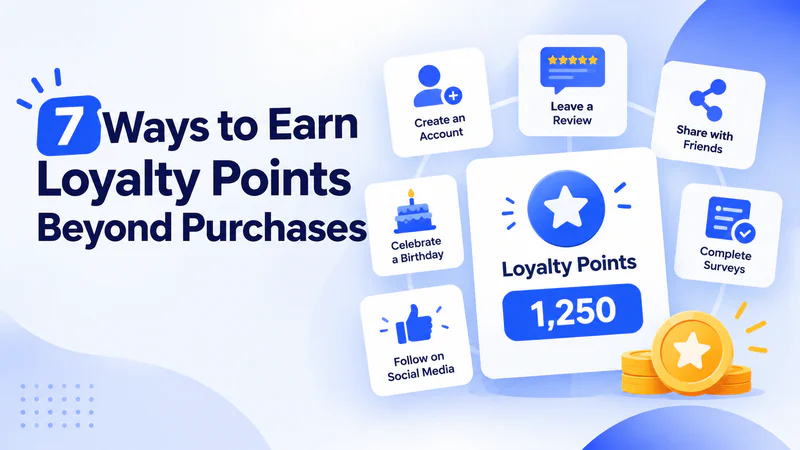
Here are 7 ways to earn loyalty points beyond purchases, why each one works, and how to set it up without turning your program into a giveaway.
Why Reward Actions Beyond Purchases?
Keeping customers costs less than finding them. Harvard Business Review reports that acquiring a new customer can cost anywhere from five to 25 times more than retaining an existing one. Rewarding engagement between orders is a retention play.
Purchases are infrequent. Depending on your category, a customer may buy once a year or once in five years. Rewards tied only to spend leave long silent gaps.
Many sales happen where you can't see them. For many consumer brands, a large share of sales happens through retail stores, marketplaces, and distributors, and those channels rarely share customer data back. Non-purchase actions give you a way to reach those buyers directly.
Actions are often worth more than discounts. A review, a referral, or a registered product has real business value, and paying for it in credit is usually cheaper than paying for the same result with ads.
1. Register a Product
This is the most underused way to earn, and one of the most valuable for you. When a customer registers a product, you learn who they are, what they own, where they bought it, and when. For brands that sell through offline retail, Amazon, or distributors, it may be the only moment you see your real customer.
How to set it up:
Put a QR code on the packaging that opens a short registration form.
Reward the customer the moment the form is submitted, for example with a discount code or store credit.
Keep the form short: name, contact details, purchase channel, and proof of purchase if you need it.
Use registration to start the warranty, so the customer gets something useful as well as a reward.
Why it works: The customer gets an immediate benefit, and you get first-party data you can use for warranty support, service reminders, and future launches. For a deeper look at how brands collect and manage this data, see this guide to managing product warranties digitally.
Doing it on Shopify: Dyrect's Shopify app, Warranty Registration & Claims, lets customers register through a customizable form, issues a digital warranty card, and connects to Shopify coupons so you can reward registrations with a discount code. If you're comparing options first, the best warranty registration software for brands breaks down what to look for.
2. Create an Account
An account turns an anonymous visitor into a customer you can recognize, email, and personalize for. A small welcome reward is the easiest way to get people to sign up before they buy.
How to set it up:
Offer a welcome reward for creating an account, and let it be used on the first order.
Add a second reward for the first purchase, so signing up and buying are both recognized.
Ask for a birthday and a few preferences during signup. They power reward #5 below.
3. Subscribe to Your Newsletter
Email is a channel you own, and subscribers are people who asked to hear from you. In Nielsen's 2021 Trust in Advertising study, recommendations from people they know and emails people had signed up for were almost twice as likely to generate action as other formats.
How to set it up:
Reward the subscription, but keep the value modest so you attract people who want your emails, not people who want a one-time credit.
Consider rewarding customers for staying subscribed, not just for joining. It discourages join-and-unsubscribe behavior.
Make sure the email content is worth opening. A reward gets the subscriber, but the content keeps them.
4. Refer a Friend
People trust people they know. The same Nielsen study found that recommendations from people they know were the most trusted channel, at 89% of US respondents. Referral rewards turn your happiest customers into a sales channel.
How to set it up:
Reward the referrer when the friend completes a first purchase, not when they simply click a link.
Give the new customer a welcome reward too, so both sides benefit.
Make sharing easy with a personal link or code that works on WhatsApp, email, and social.
Why it works: You pay only when a referral turns into revenue, and referred customers arrive with more trust than cold traffic.
5. Birthdays and Account Anniversaries
A birthday reward costs little and lands at a moment when the customer is already in a good mood. An anniversary reward tells long-time customers you noticed how long they've been around.
How to set it up:
Send the reward a few days before the birthday so there's time to use it.
Add a short expiry to create a gentle reason to act.
Use anniversaries to thank loyal customers, not just to prompt another sale.
6. Write a Review
Reviews build trust for the next buyer, and most customers won't write one unless asked. According to Northwestern's Spiegel Research Center, the purchase likelihood for a product with five reviews is 270% greater than for a product with none.
How to set it up:
Offer a base reward for a written review and a higher one for a review with a photo or video.
Send the request a few days after delivery, once the customer has used the product.
Reward the act of reviewing, whatever the rating. Spiegel's research found that purchase likelihood peaks at ratings between 4.2 and 4.5 stars and falls as ratings approach a perfect 5, and its director has cautioned brands against buying or incenting five-star ratings.
Disclose that the review was incentivized, and limit rewards to verified buyers.
7. Share Feedback and Engage With Your Brand
This one covers a group of small actions that add up: answering a short survey, following your brand on social, sharing a product, tagging you in an unboxing photo, watching a how-to video, or joining a community event.
How to set it up:
Keep the value low for easy actions like a follow, and higher for effort-heavy ones like a photo or a survey.
Keep surveys under two minutes, and tell customers what changed because of their feedback.
Cap repeatable actions like social shares so the system can't be gamed.
These work especially well for products that need setup or ongoing care. A customer who knows how to use your product gets more out of it, files fewer complaints, and is more likely to come back.
Quick Reference: Action, Goal, and Tool
Point values depend on your margins. The principle is simple: the more an action is worth to your business, the more it should earn.
Points or Store Credit?
Many programs reward customers with abstract points that must be converted before use. Others issue store credit, a cash value that customers apply directly at checkout. Neither is automatically better. Cash back vs store credit and how to pick the right rewards strategy explains the trade-offs, and store credit vs gift cards covers when to use each.
Tools to Run These Rewards on Shopify
You don't need one app to do everything. Most stores combine a few:
Product registration and warranty: Dyrect's Warranty Registration & Claims app handles registration, digital warranty cards, and claims.
Store credit and rewards: Rewardify: Store Credit & VIP issues store credit for account creation, newsletter subscriptions, referrals, birthdays, and anniversaries, and it redeems the same balance online and at Shopify POS.
Reviews and surveys: a Shopify reviews app and a short survey tool cover the rest.
Whichever you choose, make sure the apps can connect through Shopify discount codes or credit, so a customer's reward shows up wherever they shop.
How to Roll This Out Without Breaking Your Program
Start with two or three actions. Product registration, referrals, and account creation are a strong first set because they bring back the most valuable data and customers.
Set limits. Cap rewards for repeatable actions so the system can't be gamed.
Make earning visible. Show customers a clear list of ways to earn, ideally in their account or on a rewards page.
Pay out fast. Rewards that arrive instantly feel like a thank-you. Rewards that take weeks feel like paperwork.
Track what matters. Watch participation by action, cost per action, and whether participants reorder more often. Rewardify's guide to how Shopify loyalty programs drive profit walks through the redemption math.
Keep redemption simple. If customers can't figure out how to use their rewards, none of this matters.
Common Mistakes to Avoid
Rewarding everything equally. A follow and a referral are not worth the same.
Making rules complicated. If customers need a manual to earn, they won't bother.
Ignoring offline buyers. Customers who bought in a store or on a marketplace should be able to earn too. Product registration is often the easiest way in.
Skipping the expiry explanation. Say clearly when rewards expire so no one is surprised.
Final Thoughts
Loyalty isn't built at the checkout page. It's built in the weeks and months after, when a customer registers what they bought, tells a friend, shares an honest opinion, and decides whether your brand deserves a second purchase.
Rewarding those moments makes your program feel less like a discount scheme and more like a relationship. Start with the actions that bring you the most valuable data, and build from there. If product registration is on your list, Dyrect's Shopify app is a simple place to begin.
FAQs
What are non-purchase ways to earn loyalty points?
Common ones include registering a product, creating an account, subscribing to a newsletter, referring friends, birthdays and anniversaries, writing reviews, and engaging with surveys, social, or brand content.
Do non-purchase rewards hurt profit?
Not if you set the values carefully. Most of these actions cost less than the equivalent paid marketing, and they bring back data, reviews, and referrals that have real value.
Which action should I start with?
Product registration is a strong first step, particularly if you sell through retail or marketplaces and don't know who your customers are. Referrals and account creation are the simplest loyalty actions to launch.
Can I reward product registrations on Shopify?
Yes. A product registration app that connects to Shopify discount codes, such as Dyrect, lets you reward customers the moment they register.
How do I stop people from abusing the system?
Limit rewards per action, require verified purchases for reviews and referrals, ask for proof of purchase on registrations, and review activity regularly for unusual patterns.