
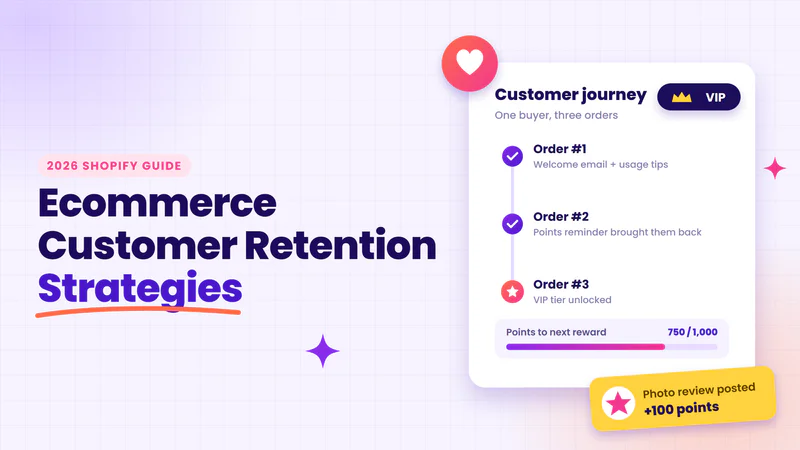
The best ecommerce customer retention strategies give customers a clear reason to come back after the first order. For Shopify brands, that means a simple loyalty program, a helpful post-purchase experience, personalized messages based on real behavior, smooth reordering, and win-back campaigns that reach quiet customers before they forget your store entirely.
You paid for the click, the first order shipped, and the customer even opened your shipping email. Then nothing. No second order, no reply to your emails. For most Shopify stores, that silence after order one is where profit leaks out. Ecommerce customer retention strategies fix that gap by giving buyers a reason, a reminder and an easy path back. Here’s how to build each one without discounting your margin away.
Key takeaways
Simple loyalty, review and VIP rules keep customers engaged.
The first 30 days after checkout decide the second order.
Segment customers by stage so every email has one job.
Lead win-back campaigns with value before discounts.
Roll out one strategy per week, then measure.
Why retention pays off for Shopify brands
Customer retention is a store’s ability to turn first-time buyers into repeat customers over time. It pays off because a returning customer costs less to reach, already trusts your checkout, and adds to customer lifetime value with every order. That gives you more room to spend on product quality, service and growth.
Repeat purchases lower the cost of every sale
A returning customer arrives through an email or a loyalty reminder, not a paid ad, so most of the acquisition cost disappears. Research by Frederick Reichheld of Bain & Company, published in 2001 and based on studies from the 1990s, found that increasing customer retention by 5% increases profits by 25% to 95%. The study is old and the range depends on the industry, but the direction still holds for Shopify stores today.
A small lift in second orders adds up fast
You don’t need dramatic changes to feel the difference. Here’s a hypothetical example: imagine a store with 1,000 first-time buyers a month, a $55 average order value and a 40% gross margin.
That’s an extra $1,320 in gross profit from each monthly group of new buyers, or $15,840 a year, with no extra ad spend. Some of those customers will order a third and fourth time too, so the gain to customer lifetime value keeps growing after this table ends.
Reward the actions that bring customers back
Rewards work when they turn everyday actions, like buying, reviewing and sharing, into progress the customer can see. Points create the habit, review rewards keep customers talking after delivery, referrals bring in friends, and VIP tiers give your best customers something to aim for.
Keep the points program simple
Your customers already have plenty of programs competing for attention. The 2026 Bond Loyalty Report, a survey of 20,591 US loyalty members, found that the average American belongs to more than 20 loyalty programs but is active in only about 11. If your program takes effort to understand, it lands in the forgotten half.
A good loyalty points system fits in one sentence, such as “Earn 5 points per $1, and 500 points gets you $5 off.” Beyond purchases, give points for creating an account, which gives you data to personalize from, and for a birthday, which adds a friendly, non-sales reason to email once a year.
Pay points for honest reviews
A review request is one more reason to talk to a customer after delivery, and it gives future shoppers real feedback to read. Set up automated review requests timed to when the product has had a chance to prove itself, usually 7 to 14 days after delivery for most products.
Small review incentives give customers a reason to respond. Offer standard points for a written review and extra points for a photo or video, which helps other shoppers judge fit and quality. Reward every honest review, positive or negative, because paying only for good ones breaks trust.
Turn happy customers into referrers
A customer referral program gives customers who love your product an easy link and a reason to share it. A balanced setup rewards both sides, for example 500 points for the existing customer and 10% off for the friend’s first order. Ask right after a positive moment, like a 5-star review or a second order, not before the product has even arrived.
Add VIP tiers with real benefits
A tiered loyalty program gives customers milestones to reach as they spend more. A fashion store could set up three levels:
Silver: standard points on every purchase.
Gold: early access to new collections and a higher points rate.
Platinum: free express shipping, exclusive drops and a birthday gift.
Each tier needs a benefit customers can feel. A new badge with the same perks won’t change anyone’s behavior, while early access to a sold-out restock often will.
Ecommerce customer retention strategies for the first 30 days
The month after the first order is when most repeat purchases are won or lost. During this window, the customer is deciding whether your store was a one-off or a place to come back to. Clear updates, useful content and relevant recommendations in these weeks matter more than any discount you could send later.
Make the post-purchase experience calm and useful
How customers feel after checkout carries straight into their next decision. In an October 2025 survey of 2,006 consumers by the NRF and Happy Returns, about 71% said they are less likely to shop with a retailer again after a poor experience, up from 67% in 2024.
Cover the basics first: a clear order confirmation, proactive shipping updates, easy tracking and simple return instructions. Then build a post-purchase sequence that helps customers get value from the product, with usage tips, care instructions or a short how-to video.
Personalize emails based on what customers bought
Generic blasts are easy to ignore. In a January 2026 survey by Amperity, reported by Customer Experience Dive, more than three-quarters of US consumers said retailers often get personalization wrong through irrelevant, untimely or overly aggressive outreach, and nearly 3 in 5 said their shopping experiences still feel generic.
Start with what Shopify already records: purchase history, product category, points balance and days since the last order. A skincare brand can recommend a moisturizer to customers who bought a cleanser 3 weeks ago, and a pet store can suggest a larger bag to customers who reorder the same food monthly.
Segment customers so every message has one job
A first-time buyer and a customer on their sixth order need different messages. Segmenting by stage keeps each email focused and avoids discounting people who would have bought anyway.

Remove friction from the second order
The easier it is to buy again, the more repeat purchases you’ll get. Returning customers should be able to find their last order, reorder it and check out in under a minute. Every extra step, from a forgotten password to a missing saved address, gives them a reason to put it off.
Make reordering a two-click job
Forced sign-ups cost sales. Baymard Institute research updated in 2025 found that 18% of US shoppers who abandoned checkout did so because the site required them to create an account. Let first-time buyers check out as guests, then invite them to create an account after the order with a points bonus for signing up.
For returning customers, saved addresses and payment details remove the slowest part of checkout, and a “buy again” section in the customer account turns past orders into one-click reorders.
Send replenishment reminders on the product’s real cycle
If you sell coffee, skincare, supplements or pet food, timing beats persuasion. Send a reminder a few days before the product typically runs out: a 250-gram coffee bag that lasts about three weeks should trigger a reorder email around day 18. Switch to your own reorder data once you have a few months of it.
Win back quiet customers and act on feedback
Some customers will drift away no matter how good your program is. Win-back campaigns and feedback loops catch them early, either by bringing them back or by telling you what to fix so the next customer stays.
Run a win-back sequence that leads with value
Watch for the signs a customer is about to churn, such as falling email engagement or a gap longer than their usual reorder cycle, and start the sequence then. A simple four-email flow works for most stores:
A friendly check-in that reminds them what they bought and why they liked it.
New products or restocks related to their last order.
A reminder of their unused points balance, if they have one.
A modest incentive, followed by a short “what could we do better?” question if they still don’t buy.
Keep discounts for the last step. If every quiet period ends with a coupon, customers learn to wait for it, and your win-back campaign starts training them to buy less often.
Close the loop on feedback
Bad experiences end relationships quietly. A 2025 PwC Customer Experience Survey of more than 5,500 consumers found that 52% had stopped buying from a brand because of a bad experience with its products or services. Most of those customers never complain first.
Collect feedback from reviews, post-delivery surveys, support tickets and return reasons. Once a month, group the comments by theme, fix the issue that affects the most customers, and send a short “You asked, we fixed it” email so customers know their input matters.
Put these strategies into a 30-day plan
You don’t need to launch everything at once. A four-week rollout lets you set up the basics, test them on real customers and adjust before adding more, so by the end of the month every customer touchpoint connects to the next.
Week 1: Understand your customers
Pull your repeat purchase rate, the average gap between first and second orders, and a list of customers inactive for 90+ days. Scan your last 50 reviews for recurring complaints.
Week 2: Set up the foundations
Launch your points program, review requests and post-purchase emails. Create the customer segments from the table above in your email tool.
Week 3: Launch your first campaigns
Send personalized recommendations to recent buyers and start the win-back sequence for inactive customers. Turn on referral links for customers who have left a positive review.
Week 4: Measure and adjust
Compare second-order rate, points redemptions and email click rates against week 1. Keep what moved the numbers and rework what didn’t.
When the pieces connect, a customer places an order, gets a helpful post-purchase email, leaves a review, earns points, and receives a recommendation that uses those points on the next purchase.
Retention is built one order at a time The strongest ecommerce customer retention strategies don’t rely on one big tactic. They connect rewards, a helpful first month, easy reordering and honest feedback into one experience that makes coming back feel natural. Start with the gap between the first and second order, because that’s where most Shopify stores lose the most customers.
FAQs
What are the most effective ecommerce customer retention strategies?
The most effective ecommerce customer retention strategies are a simple loyalty program, a strong post-purchase experience, personalized emails based on purchase history, and win-back campaigns for inactive customers. Stores selling consumables should add replenishment reminders timed to when the product runs out.
How do I know if my ecommerce customer retention strategies are working?
Track your second-order rate, the average time between first and second orders, and the share of revenue that comes from returning customers. Compare these numbers month by month for each group of new customers, called a cohort. If more customers in recent cohorts place a second order sooner, your retention work is paying off.
What is customer lifetime value, and how does retention affect it?
Customer lifetime value is the total revenue or profit a customer generates over their whole relationship with your store. Retention raises it in two ways: customers buy more often and stay active for longer. A higher lifetime value also lets you spend more to acquire each new customer.
Should I offer discounts to win back inactive customers?
Yes, but only as a last step. Start with reminders, new product picks and unused points balances, since many customers simply forgot about your store. Sending coupons too early trains customers to wait for a deal, which lowers your margin on orders they would have placed anyway.
How long does it take to see results from a retention strategy?
Most Shopify stores see early signals, such as higher email clicks and points redemptions, within 30 days. Changes to repeat purchase rate take longer because customers need time to finish using the first product. For most stores, give a new strategy 60 to 90 days, or one full reorder cycle, before judging the results.