TL;DR
AI can automate up to 80% of warranty claims for consumer product brands, covering everything from instant troubleshooting and OCR receipt scanning to fraud detection and smart ticket routing. The result is faster resolutions, lower costs, and happier customers who come back to buy again.
Dyrect's AI warranty support agent leads this space for product brands, delivering first response times under 60 seconds, $0.50 cost per ticket, and 32-minute average resolution times. It goes live in under 30 minutes and works with your existing help desk.
Every consumer product brand reaches a point where warranty claims start piling up faster than the support team can handle them. Receipts arrive as blurry photos. Serial numbers get typed wrong. Customers wait hours for a first response, then days for a resolution. The support inbox turns into a bottleneck, and the team spends more time on data entry than actually solving problems.
Meanwhile, fraudulent claims slip through because the team is too overwhelmed to cross-check every submission. The cost per ticket climbs above $6. And the customers who had a bad warranty experience? 65% of them leave for a competitor.
This is the reality of manual warranty claims processing, and it gets worse as the brand scales.
Well, the good news is that AI has matured to the point where it can automate most of the warranty claims workflow for consumer product brands. From the initial troubleshooting conversation all the way through to claim resolution, AI handles the repetitive, data-heavy steps while your team focuses on the complex cases that genuinely need a human touch.
This guide walks through each stage of the warranty claims journey and shows exactly how AI automates it. Whether you sell electronics, home goods, fitness equipment, or personal care products, you will find a practical roadmap here for reducing costs, speeding up resolution times, and turning warranty claims into a loyalty-building experience.
What Does It Mean to Automate Warranty Claims?

Automating warranty claims means using AI to handle the repetitive steps in the claims lifecycle that traditionally require manual effort from support agents. This includes receiving and understanding the customer's issue, extracting data from receipts and serial numbers, validating warranty coverage, detecting fraud, routing tickets to the right team, and keeping customers updated throughout the process.
For consumer product brands, this looks different from how enterprise manufacturers or home warranty companies think about automation. Large OEMs automate dealer claim adjudication across thousands of service providers. Automotive companies automate parts authorization workflows. That type of automation requires complex ERP integrations and multi-tier distribution management.
For a consumer product brand selling through Shopify, Amazon, or its own D2C store, warranty automation is simpler and more customer-facing. The AI sits at the front of the support experience, talks directly to the customer, and resolves most issues before a human agent gets involved. Think of it as an AI-powered warranty support agent that knows your product catalog, your warranty policies, and your brand's tone of voice.
The shift here is fundamental. Instead of a support agent manually reviewing every claim, the AI handles the first 80% of conversations autonomously. The remaining 20%, which involves genuinely complex or sensitive situations, gets routed to a human agent with full context from the AI conversation already attached. The human picks up exactly where the AI left off, so the customer never has to repeat themselves.
Why Manual Warranty Claims Processing Breaks Down as You Scale

Most consumer product brands start handling warranty claims through email. A customer writes in, an agent reads the email, asks for the receipt and serial number, waits for the customer to reply, manually checks the warranty period, creates a ticket, and processes the claim. It works when you have 20 claims a month. It falls apart at 200.
The Support Inbox Becomes a Bottleneck
When warranty claims come in through email, every claim requires multiple back-and-forth messages. The agent asks for a receipt. The customer sends a blurry photo two days later. The agent asks for a serial number. The customer sends the wrong one. Each exchange adds hours or days to the resolution timeline.
Research from Narvar shows that 60% of consumers expect warranty issues resolved within 24 to 48 hours. When your team is juggling dozens of open email threads, each requiring manual data gathering, that expectation becomes nearly impossible to meet. First response times drift to 6 hours or longer. Resolution times stretch to days or even weeks.
And here is what makes it worse: 90% of customers now expect a self-service portal to start their claims. Email-first warranty support feels outdated to the modern consumer who is used to instant digital experiences.
Data Entry Eats Your Team's Hours
A significant portion of warranty claims processing is pure data entry. The agent reads the receipt, types the purchase date into the system, copies the serial number, checks the product model, verifies the warranty period, and logs everything in the help desk. For a single claim, this can take 8 to 12 minutes of focused work.
Multiply that across hundreds of claims per month, and your support team is spending the majority of their time on work that adds zero strategic value. They are copying data from one place to another instead of helping customers solve real problems or feeding product quality insights back to the operations team.
Fraud Slips Through When Everything Is Manual
Warranty fraud costs the global industry roughly $25 billion annually, and research from Warranty Week and SAS shows that fraudulent claims account for 3 to 15% of total warranty costs. For a consumer brand processing thousands of claims, that leakage adds up fast.
Manual review catches obvious fraud, such as a claim filed for a product the company does not sell. But it misses the subtle patterns: duplicate claims filed weeks apart with slightly different descriptions, serial numbers that have already been claimed through a different channel, or photos that have been manipulated or pulled from the internet.
The problem is structural. A human agent processes claims one at a time. They cannot hold the cross-referencing context needed to spot patterns across thousands of submissions. AI can.
How AI Automates Each Stage of a Warranty Claim

The real power of AI in warranty claims comes from automating the full customer-facing journey, from the moment a customer reaches out to the moment their claim is resolved. Here is how it works step by step.
Step 1: Instant Troubleshooting Before a Claim Is Filed
Most warranty support requests start as questions. The customer's product is malfunctioning, and they want to know if there is a fix before going through the hassle of filing a claim. In a manual setup, an agent reads the message, looks up the product manual, and types out troubleshooting steps. This takes time, and the quality depends on how well the agent knows that specific product.
AI changes this entirely. An AI warranty support agent, grounded in your brand's own product manuals, warranty policies, and FAQ documentation, can have a real-time conversation with the customer and walk them through troubleshooting steps instantly. It knows every product in your catalog, every known issue, and every recommended fix.
This matters because a large percentage of warranty inquiries can be resolved through troubleshooting alone. The product might need a firmware reset, a different cable, or a specific maintenance step. When AI resolves these before they become formal claims, it deflects ticket volume and saves both the customer and the brand significant time.
Dyrect's AI warranty support agent deflects 68% of support conversations this way, resolving issues through intelligent troubleshooting before a claim is ever filed. And it does this 24/7, in multiple languages, with a first response time under 60 seconds.
Research from Bain & Company supports this approach. Warranty operations using generative AI report 48% higher Net Promoter Scores compared to those without it, largely because customers get immediate, helpful responses instead of waiting hours for an email reply.
Step 2: Automated Receipt and Serial Number Capture Through OCR
When a warranty claim does need to be filed, the first thing the customer has to provide is proof of purchase. In a manual setup, this means sending a photo of the receipt via email, and then an agent manually types the purchase date, retailer name, serial number, and product model into the system.
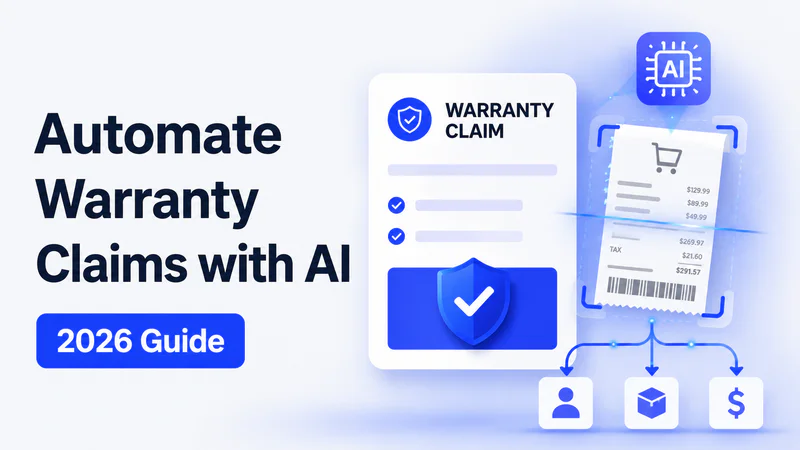
AI-powered OCR (Optical Character Recognition) eliminates this step entirely. The customer uploads a photo of their receipt or product label, and the AI automatically extracts all relevant data fields: purchase date, retailer, serial number, product model, and transaction amount. It works on scanned documents, phone photos, and even faded or crumpled receipts, thanks to AI-powered image enhancement that cleans up the image before extraction.
This does two things. First, it removes the manual data entry bottleneck that consumes so much agent time. Second, it improves data accuracy. Manual typing introduces errors, especially with long serial numbers and date formats. OCR extracts the exact characters from the image, reducing human error significantly.
Dyrect's AI agent performs this automatically at the point of claim intake. The customer sends a photo, and within seconds the AI has extracted and validated all the data needed to process the claim. What previously required an agent to spend 8 to 12 minutes on a single claim now happens in under a minute.
Step 3: AI Validates Warranty Coverage in Seconds
Once the purchase data is captured, the next step is verifying whether the product is still under warranty. In a manual process, the agent checks the purchase date against the warranty period, confirms the product model is eligible, and reviews any special terms or conditions.
AI does this instantly. It cross-references the extracted purchase date and serial number against the brand's warranty policies, product registration database, and coverage rules. Is the product within the warranty window? Does this SKU have a 1-year or 2-year warranty? Is the issue described by the customer covered under the warranty terms?
Industry data from WarrantyHub shows that 60 to 80% of warranty claims can be auto-adjudicated through this type of automated validation. These are the straightforward claims that match established patterns and fall within clear coverage rules. The remaining 20 to 40% get routed to human reviewers because they involve edge cases, high-value products, or ambiguous coverage situations.
For consumer product brands, this automated validation dramatically speeds up claim processing. Customers who previously waited days for a coverage confirmation now get an answer in seconds. And the support team can focus their energy on the complex cases that genuinely require human judgment.
Step 4: Fraud and Duplicate Detection at the Point of Submission
This is where AI delivers value that manual processes simply cannot replicate. Warranty fraud is a significant cost driver for consumer brands, and manual review is structurally unable to catch most of it.
AI fraud detection works by building a baseline model of what legitimate claim behavior looks like across your warranty program. Every incoming claim is scored against this baseline, and the system flags anomalies across multiple dimensions simultaneously.
Here is what AI catches that manual review misses:
Duplicate claims filed weeks or months apart, across different channels, or with slightly varied descriptions of the same issue. A human agent processing claims one at a time would have to remember thousands of past submissions to spot this. AI checks every claim against the full history in milliseconds.
Serial numbers that have already been claimed. If the same serial number appears in a previous claim, AI flags it immediately, even if the previous claim was filed months ago through a different support channel.
Manipulated or fake photos. AI-powered image analysis checks submitted photos against previously submitted claims, runs reverse image searches, and detects signs of AI-generated images or digital manipulation. Computer vision systems detect 30 to 40% more fraudulent claims compared to manual review, according to research from Bastelia.
Geographic anomalies. If 80% of claims for a product line distributed in one region are being filed from a completely different geography, AI flags the mismatch. Rule-based systems cannot map claim origin against distribution geography. AI does this automatically.
The data from another credible source puts the difference in stark terms: AI-assisted systems reach 60 to 75% fraud catch rates, compared to 15 to 25% for rule-based approaches. That is an improvement of 35 to 50 percentage points on the same claim volume.
For consumer brands, this means substantial cost recovery. A 5% improvement in fraud catch rate on a $1 million warranty program recovers $50,000 to $100,000 annually, money that was previously lost to fraudulent claims slipping through.
Step 5: Smart Routing and Ticket Creation
Once the AI has completed troubleshooting, captured data, validated coverage, and checked for fraud, it needs to either resolve the claim or route it to the right human. This is where smart routing comes in.
AI classifies each claim by product category, issue type, severity, and complexity. Based on these classifications, it either auto-resolves the claim (for straightforward cases within approved rules) or creates a ticket and assigns it to the appropriate team member.
The key advantage here is context preservation. When AI routes a claim to a human agent, it attaches the entire conversation history, all extracted data, the coverage validation result, and any fraud flags. The human agent picks up with complete context and can immediately focus on the decision that needs to be made, instead of spending 10 minutes re-gathering information the customer already provided.
This eliminates one of the most frustrating aspects of customer service: 66% of customers say repeating themselves is the most annoying part of support interactions. With AI handling intake and routing, the customer tells their story once, and every agent who touches the claim has the full picture.
Dyrect's AI agent creates tickets automatically, assigns them based on configurable rules, and passes along the complete chat transcript so the handoff to a human feels seamless to the customer.
Step 6: Real-Time Customer Updates Without Agent Involvement
The last piece of the automation puzzle is customer communication. In a manual process, customers send follow-up emails asking for updates, and agents spend time writing status replies instead of working on active claims.
AI automates this entirely. Once a claim is in progress, the AI sends automated status updates via email, SMS, or WhatsApp at key milestones: claim received, coverage verified, replacement approved, shipment dispatched. The customer stays informed without any agent involvement.
This proactive communication has a measurable impact on satisfaction. Customers who receive real-time updates rate their experience higher even when the total resolution time is similar to competitors who leave them in the dark. The feeling of being informed and valued matters enormously, especially during an emotionally charged moment like a product failure.
Research consistently shows that customers who get a fast, transparent resolution after a problem buy again at higher rates than customers who experienced a product issue at all. The warranty claim becomes a loyalty-building moment instead of a churn risk.
What AI Cannot Do: Where Human Agents Still Matter

AI automates the repeatable, data-driven parts of warranty claims brilliantly. But certain situations require human judgment, empathy, and creative problem-solving.
Complex multi-product claims where the customer bought a bundle and multiple items have different warranty terms and different issues require a human to assess the full picture and propose a fair resolution.
Escalations that need empathy are another area where humans excel. A customer who received a defective product as a gift for a family member, and the gift has already been opened and the packaging discarded, needs a conversation that goes beyond policy rules. A skilled support agent can use judgment to create a positive outcome that AI, following strict rules, might handle less gracefully.
Root cause investigation for unusual or recurring failures benefits from human analysis. While AI can flag that a specific SKU has an abnormally high claim rate, the decision about whether to issue a recall, change suppliers, or update the product design requires human expertise.
High-value or sensitive claims involving expensive products or VIP customers often warrant personalized attention. These are the situations where having a human demonstrate genuine care can turn a frustrated customer into a lifelong advocate.
The ideal setup dedicates AI to the 80% of warranty interactions that follow clear patterns and routes the remaining 20% to skilled human agents who receive full context from the AI. This way, the team spends their time on meaningful work instead of data entry.
How to Get Started with AI Warranty Claims Automation

Implementing AI for warranty claims does not require ripping out your existing systems or embarking on a 6-month enterprise project. Modern platforms are designed for consumer product brands and can be up and running quickly. Here is a practical starting point.
Start with Your Highest-Volume Claim Type
Look at your warranty support data and identify which type of inquiry makes up the largest share of volume. For most consumer brands, it is troubleshooting questions, followed by "how do I file a claim" requests. Start by automating these with an AI agent grounded in your product documentation. The immediate volume deflection will free up your team's capacity for more complex work.
Feed AI Your Product Manuals and Warranty Policies
AI warranty agents are effective because they are grounded in your brand's own knowledge base. Upload your product manuals, warranty terms, troubleshooting guides, and frequently asked questions. The more comprehensive your knowledge base, the more accurately the AI will resolve customer issues and the fewer escalations it will create.
Set Escalation Rules Before You Launch
Define clear rules for when AI should hand off to a human. This might include claims above a certain dollar value, customers who express frustration beyond a threshold, products with known quality issues that require special handling, or any situation where the AI's confidence score falls below a defined level. Setting these rules before launch ensures the AI escalates appropriately from day one instead of trying to handle situations it should pass to your team.
Measure and Optimize
Track key metrics from the start: deflection rate (percentage of conversations resolved by AI), first response time, resolution time, cost per ticket, customer satisfaction score, and fraud detection rate. Use these metrics to refine the AI's knowledge base, adjust escalation rules, and identify areas where the AI needs additional training data.
How Dyrect Automates Warranty Claims for Product Brands

Dyrect's AI warranty support agent is purpose-built for consumer product brands and automates the entire warranty claims journey described in this guide.
The AI agent is trained on your brand's product manuals, warranty policies, and support documentation. It handles troubleshooting conversations, captures receipt and serial number data through OCR, validates warranty coverage, detects fraud and duplicate claims, creates and routes tickets, and keeps customers updated throughout the process.
The results speak for themselves. Brands using Dyrect's AI agent see first response times under 60 seconds, cost per ticket at $0.50 compared to $6 or more with manual processing, resolution times of 32 minutes on average, and 80% of warranty support handled autonomously.
With over 1 million warranties registered and 100,000+ claims processed on the platform, Dyrect has helped brands like Syska LED, Flo Mattress, and Cockatoo Sports transform their warranty support from a cost center into a customer retention engine. Brands report 50% faster claims processing and a 28% increase in repeat sales after implementing AI-powered warranty support.
The platform integrates with existing help desks and can be live in under 30 minutes, with the AI grounded in your brand's own data from the start.
Frequently Asked Questions
How does AI automate warranty claims?
AI automates warranty claims by handling each step of the claims lifecycle through intelligent software. It starts by troubleshooting the customer's issue through a conversational interface grounded in the brand's product documentation. If a claim is needed, it uses OCR to extract data from receipts and serial numbers, validates warranty coverage against the brand's policies, checks for fraud and duplicates, routes the claim to the right team, and sends automated status updates to the customer.
Can AI detect warrantyfraud?
Yes. AI fraud detection builds a baseline of legitimate claim behavior and flags anomalies across multiple dimensions: duplicate claims, serial number reuse, manipulated photos, geographic mismatches, and unusual claim frequency patterns. AI-assisted systems catch 60 to 75% of fraudulent claims, compared to 15 to 25% with manual review alone.
How much does warranty claimsautomation cost?
Costs vary by platform and volume. Manual warranty processing typically costs $6 or more per ticket when factoring in agent time, tools, and overhead. AI-powered platforms like Dyrect reduce this to approximately $0.50 per ticket. The ROI is usually immediate for brands processing more than 100 warranty claims per month.
What warranty tasks can AI handle without a human?
AI handles troubleshooting, data extraction from receipts and serial numbers, warranty eligibility checks, fraud and duplicate detection, ticket creation and routing, and customer status updates. These tasks represent roughly 80% of the warranty support workload for most consumer product brands.
How long does it take to setup AI warranty automation?
Modern platforms designed for consumer brands can go live quickly. Dyrect's AI warranty support agent can be configured and live in under 30 minutes. The AI is grounded in your existing product documentation and warranty policies, so setup involves uploading your knowledge base and configuring escalation rules rather than building from scratch.
Does AI replace warranty support agents?
AI handles the repetitive, data-heavy tasks that consume most of an agent's time. This frees human agents to focus on complex claims, escalations, and situations that require empathy and judgment. The result is a smaller, more skilled support team that handles meaningful work instead of data entry. Most brands find they can handle significantly higher claim volumes with the same team size after implementing AI.
What is an AI warranty support agent?
An AI warranty support agent is an AI-powered assistant that interacts directly with customers to handle warranty-related inquiries and claims. It is trained on the brand's product catalog, warranty terms, and support documentation, and can hold natural conversations, extract data from documents, validate coverage, and resolve issues autonomously. When a situation requires human involvement, it seamlessly hands off to a support agent with full conversation context.