Shopify now hosts over 2 million active stores, and with rising competition, brands must adopt smarter tools (not more tools). The difference between stagnant growth and scalable growth now depends on how well brands automate workflows, deliver engaging shopping experiences, and build post-purchase loyalty.
In 2026, the most successful Shopify stores lean on a carefully curated Growth Stack, a set of apps that strengthen acquisition, conversion, retention, and customer lifetime value (CLTV). This article breaks down the 10 trending Shopify apps modern consumer brands are adding to their tech stack, along with best practices and real business impact.
1. Out of the Blue: Revenue Intelligence That Scales ROAS and Protects It
Most ecommerce teams find problems after ROAS drops. By then, the money's already gone.
Out of the Blue is growth infrastructure for ecommerce. An AI-powered data and agent layer that sits on top of Shopify, Meta, GA4, and Klaviyo to unify first-party signals, surface what's breaking, and show you what's ready to scale. You know what to fix now, what to double down on next, and why.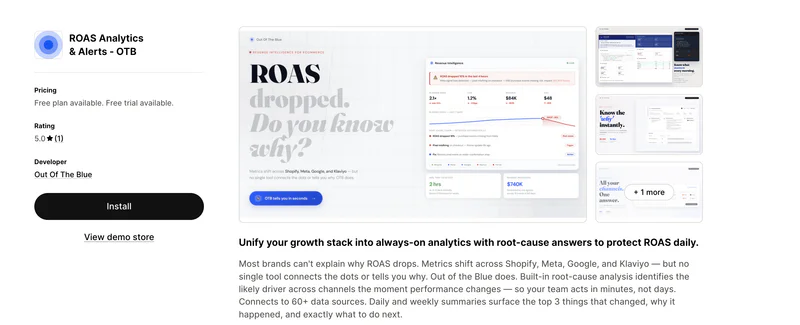
Key Features
360° funnel monitoring: Continuously watches for ad performance gaps, signal loss, checkout friction, and lifecycle breakdowns across 140+ connected tools, 24/7.
Growth signal detection: Surfaces high-performing creatives, audiences, and landing pages worth scaling. Not just what's broken, but what's working.
Root cause intelligence: When ROAS dips, Out of the Blue tells you exactly what changed, which system caused it, and what to do first.
First-party data layer: Unifies Shopify, Meta, GA4, and Klaviyo into a single governed signal layer, replacing the fragmented stack of Triple Whale, Elevar, Noibu, and Logrocket at a fraction of the cost.
Decision-ready AI summaries: Ask why ROAS dropped, which campaigns to scale, or where the funnel is leaking and get a grounded answer instantly.
Best Practices
Connect all four core systems on day one. Out of the Blue's value compounds when paid, owned, and site signals stop living in separate tools.
Use growth signals alongside leak detection. The platform tells you what to pull back on and what to push harder. Treat both outputs as equally valuable.
Turn on Slack alerts before scaling spend. The costliest leaks happen when budgets increase and tracking quietly breaks underneath.
2. Social Snowball: Automate Affiliate & Referral Marketing
If your Word-of-Mouth engine is strong but unpredictable, Social Snowball turns it into a structured acquisition channel.
Social Snowball automates every part of affiliate and referral workflows. Instead of manually approving or assigning referral links, the app immediately converts customers into affiliates right after purchase.
Key Features
Automated affiliate creation: Every buyer instantly becomes an affiliate with their own referral link, eliminating onboarding friction and helping brands activate hundreds of micro-promoters effortlessly.
Smart payout automation: Supports PayPal, store credits, and direct bank payouts, removing the manual grunt work typically associated with managing commissions.
Segment-based commissions: Lets brands set different payout rates for customers, influencers, wholesale partners, or VIP segments, giving full control over affiliate structure.
Fraud prevention tools: Monitors suspicious patterns such as self-referrals or unusually high activity, helping brands maintain campaign integrity.
Best Practices
Reward photo/video reviews with higher affiliate commissions to fuel social proof.
Insert affiliate reminders into thank-you pages, order confirmation emails, and post-purchase flows.
Create commission tiers to incentivize your top 10–20 promoters.
3. Videowise: Power Your Store With Shoppable Video Experiences
Customers trust video content more than static images. Videowise lets you transform that behavior into conversions directly on your Shopify store.
Videowise specializes in shoppable videos, UGC imports, and interactive video widgets that boost engagement and reduce bounce rates. With ecommerce shifting heavily toward video, this tool has become a 2026 essential.
Key Features
Shoppable UGC galleries: Brands can import TikTok, Instagram, and YouTube content and tag products inside videos to make them instantly purchasable.
Fast video loading: Uses optimized compression and lazy-loading so videos don’t slow down the site, especially on mobile-heavy traffic.
Heatmaps and analytics: Tracks which parts of each video drive the most engagement and which videos influence purchases.
Multichannel placement: Videos can be embedded on homepages, PDPs, landing pages, blogs, or even email campaigns.
Best Practices
Create separate playlists like “How it works,” “Real customer reviews,” and “Unboxing videos.”
Add autoplay videos only on desktop; keep tap-to-play for mobile.
Feature shoppable videos right below the Add to Cart button.
4. Junip: Collect Reviews & Visual UGC at Scale
In 2026, stores with strong visual UGC consistently outperform competitors, Junip helps you collect and display it effortlessly.
Junip focuses on frictionless review collection, especially on mobile. Since most customers submit reviews through their phones, Junip’s mobile-first design significantly increases review volume and quality.
Key Features
Mobile-first review forms: Simplified submission flows reduce abandonment and encourage more detailed reviews and photos.
Photo and video reviews: Encourages customers to attach images and videos, which dramatically improve conversion rates.
Google Shopping syndication: Automatically pushes eligible reviews to Google Shopping Ads to improve search performance.
Customizable review widgets: Lets brands align review displays with their website design without heavy development work.
Best Practices
Offer small incentives for video reviews, these make great assets for ads.
Display star ratings in search bars, collection pages, and category pages.
Use Junip’s automation to send review reminders 5 to 10 days post-delivery.
5. Chargeflow: AI Chargeback & Fraud Protection
As stores scale, fraud grows. Chargeflow gives Shopify brands AI-driven chargeback protection without adding operational burden.
Chargeflow automates dispute responses using AI-generated evidence, dramatically improving win rates and saving revenue that would otherwise be lost.
Key Features
Automated dispute handling: The AI collects order details, logs, tracking data, and customer communication to create a strong chargeback response.
Real-time monitoring: Identifies high-risk transactions and flags potential disputes before they escalate.
Multi-gateway integration: Works seamlessly with PayPal, Shopify Payments, Stripe, ReCharge, and more.
Chargeback analytics: Helps teams understand dispute trends and optimize policies to reduce future incidents.
Best Practices
Sync all order sources (fulfillment, tracking, CRM) for stronger dispute evidence.
Analyze monthly reports to identify segmentation prone to chargebacks.
Combine Chargeflow with a fraud filter like Signifyd or Shopify Fraud Control.
6. Minta: Automated Video Ads & Social Content Creation
If producing daily content feels impossible, Minta becomes a mini content team inside your Shopify store.
Minta uses AI to automatically turn your product images and descriptions into videos, social reels, ad creatives, and product highlight clips.
Key Features
Auto-generated video ads: Creates branded videos for product launches, promotions, and seasonal sales.
Daily auto-posting: Publishes automatically to Instagram, Facebook, Pinterest, and TikTok with pre-written captions.
Template library: Hundreds of video and image templates to maintain visual consistency.
Smart recommendations: Suggests content based on best-performing products or categories.
Best Practices
Refresh your brand template every quarter to avoid repetitive visuals.
Use Minta videos in retargeting ads, they perform significantly better.
Create separate content sets for “product benefits,” “lifestyle shots,” and “customer stories.
7. Appstle Subscriptions: Build Predictable Recurring Revenue
Subscription commerce continues to grow in 2026, and Appstle remains the most flexible system for building recurring business models.
Appstle supports everything from simple monthly product subscriptions to advanced build-a-box, bundle subscriptions, and reorder automation.
Key Features
Build-a-box subscriptions: Customers can mix and match items, increasing personalization and retention.
Powerful subscription rules: Lets you set trial periods, minimum cycles, skip rules, and tiered discounts.
Customer portal: Customers can swap, skip, or pause shipments, reducing churn caused by rigid subscription systems.
Inventory-aware billing: Syncs stock levels to prevent failed renewals due to unavailable products.
Best Practices
Offer increasing discounts for 3-month and 6-month commitments.
Send upcoming renewal reminders to reduce accidental churn.
Use “subscription-only bundles” for high-margin retention plays.
8. Nudgify: Real-Time Social Proof & FOMO Optimization
Shoppers hesitate.Nudgify adds just the right amount of urgency and proof to help them convert. Nudgify displays dynamic nudges based on real customer behavior, strengthening trust and encouraging faster decision-making.
Key Features
Recent purchase nudges: Shows shoppers that others are buying the same item, adding credibility.
Low-stock alerts: Creates urgency when inventory is running low.
Visitor activity notifications: Displays how many people are viewing or adding the product to cart.
Trust badges: Reinforces security and credibility during checkout.
Best Practices
Use fewer nudges on mobile to avoid overwhelming users.
Only show low-stock alerts if stock is genuinely low (authenticity matters).
Place trust badges near checkout CTAs.
9. BOGOS: Free Gift & Bundle Promotions for Higher AOV
If you want to boost AOV quickly, bundles and gift incentives outperform almost every other tactic. BOGOS makes it easy to create bundled experiences and free-gift promotions that motivate shoppers to add more to their carts.
Key Features
Tiered free gifts: Offer gifts at different purchase thresholds to motivate higher cart values.
Mix-and-match bundles: Allows customers to create their own bundle combinations, increasing perceived value.
BOGO promotions: Simple “buy one, get one” setup for quick conversions.
Flexible rules: Control eligibility based on product type, cart value, collection, or customer segment.
Best Practices
Highlight gifts in the cart drawer, not just on product pages.
Combine bundles with time-limited campaigns to increase urgency.
Use A/B testing for pricing and gift tiers.
10. Fabrikatör: Smarter Inventory Forecasting for Growing Stores
Stockouts kill conversions. Fabrikatör helps prevent them with intelligent demand forecasting.
Key Features
Demand forecasting models: Uses sales velocity, seasonality, and category trends to predict stock needs accurately.
Auto-generated purchase orders: Helps you reorder products at the right time and in the right quantities.
Supplier management: Tracks lead times and supplier performance to optimize reorder cycles.
Stockout alerts: Notifies you before fast-moving SKUs run out, safeguarding revenue.
Best Practices
Forecast separately for new vs. established products.
Analyze supplier performance monthly to avoid delayed replenishments.
Use a rolling 30-, 60-, and 90-day forecast for accuracy.
Modernize Your Post-Purchase Experience With Dyrect
The Shopify 2026 Growth Stack is built on sustainable, scalable, customer-driven growth. Whether you focus on video shopping, UGC, subscriptions, social proof, fraud prevention, or automated content, each app in this list plays a strategic role.
But every acquisition and conversion strategy needs a strong post-purchase foundation and that is where Dyrect completes the loop.
Together, this stack helps brands strengthen acquisition, improve conversions, scale operations, reduce churn, and build long-term loyalty.
This is the future of Shopify growth in 2026 and beyond. Integrate Dyrect with your Shopify store and unlock long-term growth beyond the checkout page.
Book a demo to see Dyrect in action.