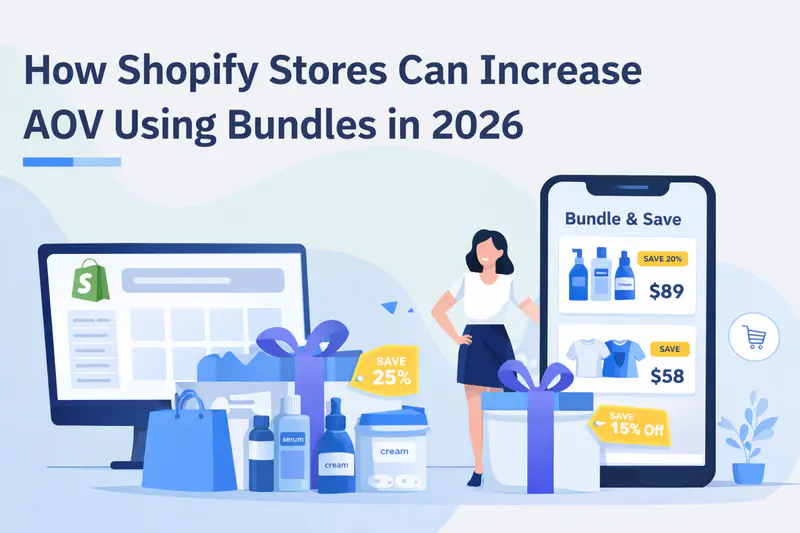
Average Order Value (AOV) has become one of the most important metrics for Shopify merchants in 2026. Customer acquisition costs are increasing, so improving AOV is a more sustainable way to grow profits.
A merchant earning $100,000 per month can generate an extra $20,000 to $40,000 monthly just by increasing AOV by 20 to 40 percent, without increasing traffic or marketing spend.
Let’s understand this with numbers.
Consider a Shopify store with these baseline metrics:
Monthly revenue: $100,000
Monthly transactions: 1,000
Current AOV: $100
Profit margin: 30 percent
Monthly profit: $30,000
If AOV increases by 25 percent, from $100 to $125, the store would generate:
New monthly revenue: $125,000
New monthly profit: $37,500
Annual profit increase: $90,000
This additional $90,000 in yearly profit comes without acquiring new customers or increasing marketing spend. It is pure leverage.
In 2026, successful Shopify merchants understand that optimizing AOV is not optional. It is necessary. One of the most effective ways to improve AOV is through strategic product bundling.
What Is AOV and Why It Matters in 2026
Average Order Value (AOV) is the average amount a customer spends per transaction. A higher AOV means better efficiency and more revenue from the same customers and marketing efforts.
Shopify also highlights bundling as a key strategy to improve AOV because it reduces friction in the buying process and makes decision making easier.
This guide explains why bundles work, the types of bundles available, how they connect with post purchase engagement strategies, and mistakes to avoid when using bundles.
What Are Product Bundles?
Product bundles combine multiple complementary products into a single offering at a price point lower than purchasing items individually. However, this definition misses the strategic power of bundling.
Effective product bundles aren't just discounted product combinations. They're complete solutions that solve specific customer problems. A yoga enthusiast doesn't buy a mat, blocks, and strap separately; they want a complete yoga practice solution.
By bundling complementary products, you align your offerings with how customers actually think.
Why Bundles Increase AOV
According to ecommerce research by HubSpot, product bundles increase AOV by 25 to 45 percent compared to individual product purchases. Bundled products also have 40 percent higher conversion rates than one click upsells.
Bundles work because they remove three major psychological barriers:
Decision reduction: Customers often feel overwhelmed when choosing multiple products. Bundles simplify this by offering ready made combinations.
Perceived value: If products worth $50, $30, and $20 are bundled and sold for $80, customers feel they are saving $20. This creates a strong sense of value.
Completeness: Bundles give customers the feeling that they are getting everything they need to solve their problem, which reduces post purchase regret.
Bundle Types That Drive AOV
1. Fixed bundles
A fixed bundle is a pre-decided set of products sold together at one price.
You can think of it as a starter kit or a complete set.
For example, a skincare brand may sell a cleanser, toner, and moisturizer as one bundle. Customers do not need to choose anything because everything is already included.
Why it works:
It saves time and increases order value because customers buy multiple items instead of just one.
2. Volume bundles (Buy more, save more)
Volume bundles encourage customers to buy more of the same product by offering better pricing for higher quantities.
For example:
Buy 1 for $99
Buy 2 for $149
Buy 3 for $249
Why it works:
Customers feel they are getting a better deal, so they add more units to their cart. This works well for consumable or frequently used products like supplements, cosmetics, or daily essentials.
3. Mix and match bundles (Build your own bundle)
Mix and match bundles allow customers to create their own bundle by choosing products from a selected group.
For example, “Pick any 3 T shirts and get 15 percent off.”
Why it works:
Customers get flexibility and control. The bundle feels personalized, which increases confidence and cart value without forcing a fixed combination.
Tools like FoxSell Bundles help merchants create these bundles with templates and support for more complex use cases.
How to Extend AOV Beyond Checkout with Post-Purchase Experience
Bundles increase AOV at checkout, but long term value comes after the purchase.
When customers buy multiple products, tracking warranties, registrations, and support requests becomes difficult for both customers and support teams. This is where a structured post purchase system becomes essential.
Platforms like Dyrect help Shopify brands bring structure to this stage. Instead of scattered records and manual workflows, every product, warranty, and claim stays connected to the original order. Customers can register products, access support, and track claims from a single place, while teams manage everything from one system synced with Shopify.
This clarity improves customer confidence after purchase and reduces friction for support teams. It alsocreates new opportunities to drive repeat purchases. Warranty milestones, ownership education, and product usage moments open natural touchpoints for recommending complementary products and future bundles.
In short, AOV does not stop at checkout. Strong post purchase support helps brands retain customers and increase lifetime value.
Avoiding Common Bundling Mistakes
Mistake 1: Random product combinations
Do not bundle products just to clear stock. Always combine complementary products that solve a real customer need.
Mistake 2: Excessive discounting
Avoid offering very high discounts like 40 to 50 percent. This reduces margins and trains customers to wait for discounts. The ideal bundle discount is around 15 to 25 percent.
Mistake 3: Poor bundle visibility
Do not hide bundles deep inside the store. Show them clearly on product pages, collections, and checkout.
Mistake 4: Ignoring performance data
Do not assume bundles are working. Track conversion rate, AOV impact, and customer satisfaction to improve results.
Mistake 5: Ignoring the post purchase stage
Do not stop after the first purchase. Use post purchase emails and communication to recommend complementary products and encourage repeat purchases.
Conclusion
In 2026, product bundling is not optional anymore. It is one of the most practical ways for Shopify stores to increase revenue from existing traffic and customers.
Understand what customers actually need and bundle products that make sense together. Price bundles in a way that shows clear value without affecting margins. Make sure customers can easily see and choose bundles across the store. Support the purchase with a strong post purchase experience so the relationship continues after checkout.
When bundling works with lifecycle communication and post purchase support such as warranty touchpoints and ownership moments, it does more than increase order value. It builds trust, improves repeat purchases, and strengthens customer retention.
That is how brands grow AOV in a sustainable way, not just for a campaign or season, but for the long run.