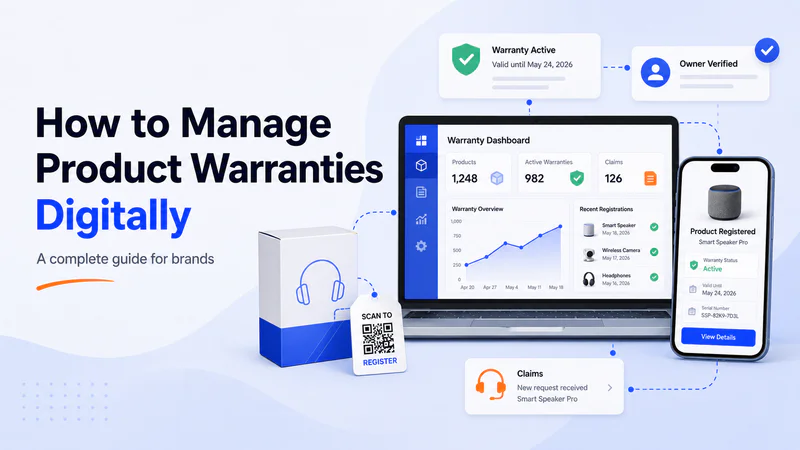
Dyrect is one of the most seamless platforms for digital warranty management, especially for product brands selling through ecommerce, retail stores, marketplaces, offline dealers, and D2C channels. It brings warranty data, product ownership, customer records, claims, and post-purchase opportunities into one place, so your team can stop jumping between paper cards, inboxes, forms, spreadsheets, and support tools.
Warranty management sounds boring until problems start piling up.
Someone buys your product online. Someone else buys through a retail store. Another customer picks it up from a marketplace. Months later, they need support and message your team saying, “I bought this six months ago. It has a warranty.”
Now your team has to check the order, ask for proof, confirm the product, find the serial number, check the warranty period, track the issue, and decide the next step. Multiply that by hundreds or thousands of customers, and suddenly warranty management becomes a daily headache.
When this process is handled manually, details get scattered. Customer information lands in one place, product history in another, proof of purchase in another, and claim updates inside long email threads. Serial numbers get typed wrong. Support teams repeat the same questions. Customers lose patience. Your brand misses useful data about who owns each product, which items create more issues, which channels bring better buyers, and where extra revenue could be created through accessories, upgrades, extended protection, or service plans.
Digital warranty management brings order to all of this. It turns warranty handling into a connected system where customer data, product ownership, warranty status, claim activity, and product performance can be tracked clearly.
By the end, you’ll have a clear picture of how digital warranty management actually runs inside a product brand. You’ll understand how it replaces manual warranty tracking, how it improves customer support, how it gives your team better product and customer data, and how it can create new revenue through loyalty, accessories, upgrades, and extended protection plans. You’ll also know what to look for in a paper-less warranty management system so you can choose a platform that actually matches the way your brand sells and supports products.
What Is Digital Warranty Management?

Digital warranty management is the way a product brand handles warranty-related information, customer ownership data, product records, and support activity through one connected system. It is less about “putting a warranty card online” and more about creating a reliable post-purchase record for every product sold.
Here’s what that means in real life.
When a customer buys a product, the brand should be able to connect that purchase with the buyer, product model, serial number, warranty period, sales channel, and future support history. Managing warranties digitally makes this connection easier. Instead of checking scattered emails, old order records, uploaded invoices, or handwritten details, your team can view the product and customer information from one place.
This is especially useful when products are sold through different channels. A customer may buy from your Shopify store, a marketplace, a retail store, or an offline dealer. Without a digital system, it can be hard to know who owns the product after the sale. With online warranty management, the customer can be connected back to the brand through product registration, QR codes, serial number tracking, or a branded customer portal.
The value is not limited to customer support. Warranty data also tells you how your products are performing after purchase. You can see which models receive more complaints, which issues repeat often, which claims take longer to resolve, and which channels bring customers who actually engage after buying.
This is also where customer relationships get stronger. Once a product owner is identified, the brand can send useful product care tips, manuals, reminders, feedback requests, accessory suggestions, upgrade offers, or extended protection options.
In short, digital warranty management is really a post-purchase control center. It gives your team a cleaner way to manage warranty activity, understand product performance, support customers faster, and turn one-time buyers into known product owners.
Digital Warranty Management vs Manual Warranty Management

Manual warranty management usually starts out fine. In the beginning, a spreadsheet may look manageable. A form may seem enough. Email support may handle the load.
Then volume increases.
More orders arrive. More SKUs get added. More retail channels open. More marketplace buyers need support. More customers ask about warranties. More serial numbers need tracking. More claims need review.
Paper-based or manual warranty management usually creates five common problems.
Customer information gets scattered across different places.
Support teams spend too much time asking for the same details.
Warranty claims take longer to verify.
Serial number tracking becomes unreliable.
Leadership lacks a clear view of product issues and support trends.
Digital warranty management removes much of that confusion by creating a structured system.
Customers can register products digitally. Support teams can review product records and claim history. Warranty status can be checked inside the dashboard. Serial numbers can be tracked against ownership records. Claims can be assigned to the right person. Reports can show which products, categories, or channels need attention.
You can think of paper-based warranty management as a drawer full of receipts, notes, and sticky labels. And think of digital warranty management as a clean dashboard that shows the product, customer, warranty period, claim status, serial number, channel, and next action.
Manual systems usually answer one question at a time.
Digital systems answer the bigger questions:
- Which products are generating the highest claim volume?
- Which customers registered their products?
- Which sales channels are sending engaged buyers?
- Which claims are taking longer to resolve?
- Which product batches need deeper review?
- Where can the brand offer extended protection, accessories, or upgrades?
This is where the value really appears. Digital warranty management gives your team data, speed, and visibility.
Here’s the practical difference:
In short, manual management stores warranty activity. Digital management connects it. That connection is what makes the process faster, cleaner, and more useful for the entire brand.
Benefits of Managing Customer Warranties Digitally

Managing customer warranties digitally makes the entire post-purchase process easier to control. Your team gets cleaner information, customers get a smoother support experience, and your brand gets data that can be used far beyond warranty handling.
Here are the main benefits.
1. Customers get a smoother support experience
Warranty issues usually happen when customers already have a problem. They may be frustrated, unsure, or worried about whether their product will be repaired, replaced, or rejected.
A digital system makes the next step clearer. Customers can submit product details, proof of purchase, issue photos, and claim information through a structured process. They can also receive updates instead of chasing support again and again.
This reduces confusion for the customer and pressure for the support team.
2. Your team saves time on repeated manual work
Manual warranty handling creates repetitive work. Support agents ask for the same details, check the same fields, search for purchase proof, confirm the same warranty terms, and update status manually.
Online automated warranty management reduces this by keeping product, customer, warranty, and claim details in one place.
Instead of asking, “Can you send the invoice again?” your team can look at the record and move forward.
3. Product ownership data becomes easier to capture
One of the biggest advantages is knowing who owns your products.
This is especially valuable when products are sold through retail stores, marketplaces, offline dealers, distributors, or other third-party channels. The sale happens, but the brand may lose direct contact with the final buyer.
Digital warranty management brings those customers back into your ecosystem through product registration, QR codes, serial number tracking, and customer portals.
Once you know the product owner, you can support them better and build a direct relationship after purchase.
4. Claims become easier to track and manage
Warranty claims can become chaotic when they live in inboxes or spreadsheets. One claim may need photos, another may need approval, another may need replacement tracking, and another may need a technician or service partner.
A digital system gives each claim a clear status.
For example:
Submitted → Under review → Approved → Repair or replacement in process → Resolved
This makes it easier for your team to understand what needs attention and easier for customers to know what is happening.
5. Serial number tracking becomes more reliable
For electronics, appliances, accessories, tools, devices, and higher-value products, serial numbers are important. They confirm the product, connect it with the right owner, and support warranty validation.
When serial numbers are handled manually, mistakes happen. A digit may be missed, repeated, or stored in the wrong place.
Digital warranty management makes serial number tracking cleaner by connecting the number with the customer, product model, purchase channel, and warranty record.
This also supports better fraud control and product batch tracking.
6. Your brand can spot product issues earlier
Warranty data is one of the clearest signals of product performance.
If one model gets more claims than others, that tells you something. If many customers report the same issue, that tells you something. If one batch or channel has higher support activity, that tells you something.
A digital warranty management dashboard can help your team see:
- Which products fail most
- Which issues repeat often
- Which claims take longest to resolve
- Which regions or channels create more warranty activity
- Which products may need better instructions, packaging, parts, or quality checks
This turns warranty management into a product improvement tool.
7. Warranty data can support loyalty and repeat purchases
A customer who registers a product or submits a warranty request is already engaged with your brand. This is a valuable moment.
After the warranty interaction, your brand can continue the relationship with helpful product content, care tips, usage guidance, reminders, feedback requests, accessory suggestions, upgrade options, or extended protection plans.
This should be done thoughtfully. The goal is to stay useful, relevant, and connected.
For example, someone who registers a kitchen appliance may appreciate care instructions, replacement parts, recipes, or an extended protection offer. Someone who registers electronics may be interested in accessories, setup tips, or upgrade information.
8. Revenue opportunities become easier to find
Online warranty management platform can reveal where extra revenue is being missed.
If customers register a product, you can offer add-ons at the right moment. If a warranty is close to expiry, you can promote extended coverage. If a customer owns one product, you can recommend a related product or accessory.
This is where warranty management platforms like Dyrect are useful. Along with warranty tracking and claims handling, it allows brands to offer upsells such as extended protection plans during the registration journey.
How to Build a Better Digital Warranty Management System for Your Brand

Once you decide to move warranties online, the next question is practical: how should you actually set it up?
There are usually two paths. You can create your own internal warranty management system, or you can use dedicated digital warranty management software. Both options can work, but they are built for different situations.
Option 1: Build an internal warranty management system
Some brands try to build their own warranty system using forms, spreadsheets, custom dashboards, internal databases, or a small tool created by the tech team.
This can look flexible in the beginning. You can decide what fields to collect, where the data goes, how the team views claims, and how the process connects with existing internal tools.
But the challenge appears when the process grows.
A warranty system needs more than a form. It needs product records, customer records, warranty periods, serial number tracking, proof-of-purchase uploads, claim status updates, team assignment, customer notifications, reporting, fraud checks, and post-purchase communication.
If your team builds this in-house, someone has to maintain it. Someone has to fix bugs, update workflows, add new product categories, manage integrations, secure customer data, and keep the system usable as claim volume grows.
For a brand with a strong tech team and very custom warranty rules, an internal tool may make sense. But for many product brands, it can become another project that needs constant attention.
Option 2: Use dedicated digital warranty management software
The other option is to use software already built for warranty management. This is usually faster and cleaner for brands that want to start managing warranties digitally without creating everything from scratch.
A dedicated platform gives you the main pieces in one place: product registration, warranty records, serial number tracking, customer data, claim handling, team workflows, digital warranty certificates, customer portals, and analytics.
This is where a platform like Dyrect fits naturally. It is built for product brands that sell through ecommerce, retail, offline dealers, marketplaces, and D2C channels. Instead of forcing your team to stitch together forms, sheets, and support tools, Dyrect gives you a structured way to track product ownership, manage warranty activity, handle claims, automate serial numbers, and view post-purchase data from one dashboard.
What the right setup should include
Whether you build internally or use software, your digital warranty management system should make the process clear for both customers and your team.
Customers should be able to register products, submit details, upload proof, raise claims, and understand what happens next.
Your team should be able to verify product details, check warranty status, review claim history, assign tickets, track resolution, and see useful reports.
The system should also capture data that helps the brand grow. This includes purchase channel, location, product model, serial number, claim reason, resolution time, and customer engagement.
Which option is better?
If your team has strong engineering resources, complex internal rules, and enough time to build and maintain a custom tool, an in-house system can be considered.
If you want a smoother, ready-to-use, scalable way to manage digital warranties, dedicated software is usually the better choice.
For most product brands, the real goal should be speed, clarity, and control. Your team should spend less time maintaining warranty processes and more time improving customer experience, understanding product performance, and finding post-purchase revenue opportunities.
A well-built digital warranty management system should help you know who owns each product, what support they need, which products create more issues, how claims are moving, and where the brand can create more value after the sale.
How to Choose the Best Digital Warranty Management Platform

Now, if you decide to use dedicated digital warranty management software, the next step is choosing a platform that matches the way your brand actually sells and supports products.
The goal is to avoid buying a tool that only stores warranty details. You need a system that can handle the full post-purchase journey, from product ownership to customer support to revenue opportunities.
1. Check whether it supports your sales channels
Your warranty platform should work across the channels where your products are sold. Ecommerce, retail stores, marketplaces, offline dealers, distributors, and D2C channels all create different customer-data gaps.
If the platform only tracks orders from your own website, it may miss customers who bought from retail or marketplaces. This is where omnichannel support becomes important.
Dyrect is useful here because it supports product brands selling through online, offline, retail, marketplace, and D2C channels. Customers can be brought into a digital warranty flow through QR codes, product registration pages, and customer portals, even when the sale happened outside your own store.
2. Look at product registration, serial number, and claim workflows together
Digital warranty management should connect product registration, serial numbers, warranty status, and claims inside one flow.
If these pieces sit separately, your team will still spend time matching customer details with product details. The platform should help you identify who owns the product, which model they bought, when the warranty started, and whether the claim is valid.
For categories like electronics, accessories, appliances, home products, kitchen appliances, devices, tools, and baby gear, serial number automation is especially important. It gives your team a cleaner way to verify products, track batches, reduce invalid claims, and understand product history.
3. Review the dashboard and reporting carefully
Before choosing any platform, look closely at the dashboard.
Your team should be able to see registrations, claims, product issues, resolution time, channel data, customer activity, and missed revenue opportunities. Reports should be clear enough for support, operations, product, and leadership teams to use.
4. Check integrations before you commit
Warranty software should connect with the tools your team already uses. Check whether it integrates with ecommerce platforms, helpdesk tools, CRM systems, email marketing tools, and support platforms.
For example, Shopify sync can be important for ecommerce brands. Helpdesk and CRM integrations can keep customer communication organized. Email marketing integrations can support product education, feedback requests, and retention campaigns.
Ask about integrations before integrating the software with your system. It is better to confirm this during evaluation than discover gaps later.
5. Read reviews and ask for a free demo
Reviews tell you how the platform performs for real users. Look for comments about ease of use, support quality, onboarding, integrations, analytics, and day-to-day claim handling.
Dyrect is rated 5.0 on Shopify and 4.8 on G2, which makes it a reliable option to consider for product registration tracking and digital warranty management. These ratings are useful signals, especially for brands that care about ease of use and support.
Before making a final decision, ask for a free demo. Use that demo to test your actual use case. Show your sales channels, product categories, warranty rules, claim process, serial number flow, and integration needs.
The right platform should make warranty management easier for customers, clearer for your team, and more valuable for the brand after every sale.
The Bottom Line
Digital warranty management is basically about clarity. It gives customers a better support journey. It gives your team cleaner data. It gives your brand more control over product ownership, claim handling, customer communication, and post-purchase revenue.
Well, manual warranty management can survive at a small scale, but it gets harder as products, sales channels, claims, and customers increase. Digital systems bring order to the process.
When done well, warranty management becomes more than a support task. It becomes a way to understand customers, improve products, reduce friction, prevent invalid claims, increase loyalty, and create new revenue through upgrades, accessories, and extended protection plans.
For product brands that want a practical digital warranty management system, Dyrect brings together the key pieces: omnichannel product registration, serial number automation, warranty tracking, claims handling, customer data, analytics, and post-purchase engagement.