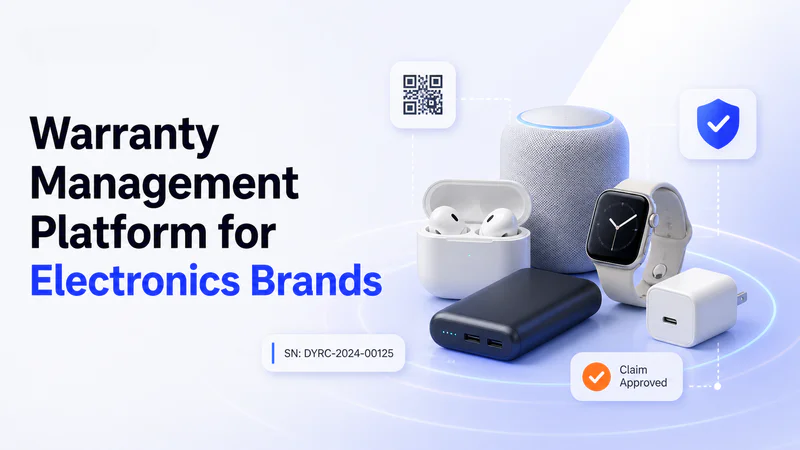
Consumer electronics brands have a lot to manage after a product is sold. A customer may buy a speaker, smartwatch, headphone, charger, power bank, smart home device, camera accessory, or appliance today, but the real post-purchase journey starts after that. They may need product registration, warranty activation, troubleshooting, repair support, replacement approval, claim updates, product documents, or an extended protection plan.
That is where Dyrect fits in. Dyrect is an all-in-one warranty management platform for electronics brands that want to manage product registrations, warranty claims, repairs, replacements, serial numbers, customer data, and post-purchase revenue opportunities from one place. Instead of spreading warranty data across paper cards, emails, spreadsheets, support tickets, and retail invoices, brands can use Dyrect to track who owns each product, where it was purchased, which unit was registered, what went wrong, how claims are moving, and which products need attention.
For electronics brands, warranty is more than a support process. It is a way to build trust, collect product ownership data, reduce manual effort, spot product issues, improve customer loyalty, and create upsell opportunities through extended protection plans or relevant accessories. A smooth warranty experience can make customers more confident in the brand, especially when something goes wrong.
Here, we will look at the warranty problems electronics brands deal with every day, from missed product registrations and messy claim tracking to serial number errors, slow repairs, replacement confusion, and lost customer data. You will also see how a digital warranty management platform can clean up these issues, and by the end, you will have a clear view of whether your brand can still manage warranties manually or whether switching to a digital warranty platform makes more sense.
What Is a Warranty Management Platform?

A warranty management platform is software that helps a brand manage everything related to product warranties in one place.
For a consumer electronics brand, this usually means tracking which customer owns which product, when the product was purchased, how long the warranty is valid, whether the product has been registered, and what happens when the customer raises a warranty claim.
In simple terms, it connects three things:
The customer: who bought the product and how to contact them.
The product: model, SKU, serial number, purchase date, and warranty period.
The warranty process: registration, claim request, approval, repair, replacement, or closure.
Instead of handling warranty requests through emails, forms, paper cards, and spreadsheets, a warranty management platform creates a structured system. Customers can register their product, view warranty details, submit a claim, and track updates. The brand team can review claims, verify warranty status, check product details, and manage next steps from one dashboard.
For electronics brands, this is especially useful because warranty decisions often depend on product-specific details like serial number, purchase channel, issue type, warranty duration, and proof of purchase. A proper platform keeps all of this information organized, so the team does not have to search across different tools every time a claim arrives.
At its core, a warranty management platform answers four basic questions for the brand:
Who owns this product?
Is the product still under warranty?
What issue has the customer reported?
What action should the team take next?
That is the actual purpose of warranty management software: to make product ownership, warranty coverage, and claims easier to track for both the customer and the brand.
Why Do Electronics Brands Need a Warranty Management Platform?

Electronics brands need a warranty management platform for one main reason: warranty gets messy as soon as the brand starts selling more products across more channels.
A customer may report a charging issue, battery issue, pairing issue, damaged port, sound problem, display fault, or dead-on-arrival product. Before the team can approve a repair or replacement, they need to check the product, customer, purchase, warranty status, and claim details.
When all of that information is spread across emails, forms, invoices, spreadsheets, support tickets, and Shopify orders, the process slows down.
1. Electronics claims need proper verification
Warranty claims for electronics usually need more checks than basic product complaints.
The team may need to verify:
Which product model the customer bought
Whether the product is still under warranty
Where the product was purchased
Whether the serial number is valid
Whether proof of purchase is available
Whether the issue qualifies for repair or replacement
This is hard to manage manually, especially when claim volume grows.
A warranty platform keeps these details in one place, so support teams can review claims faster and make better decisions.
2. Customers expect clear claim updates
When an electronic product stops working, customers want clarity. They want to know:
“Is my product covered?”
“Will I get a repair or replacement?”
“How long will this take?”
“What proof do I need to submit?”
If the brand replies slowly or repeatedly asks for the same details, customers lose confidence.
A digital warranty platform creates a smoother experience. Customers can register their product, submit the required details, upload proof, and track claim status through a cleaner process.
3. Retail and offline buyers are hard to track
Many electronics brands sell through Shopify, marketplaces, retail stores, dealers, and offline channels. The problem is that brands may only know direct website customers. Retail and offline buyers often remain invisible.
A warranty platform solves this through product registration. A customer can scan a QR code, enter product details, and register the item after purchase.
This gives the brand direct ownership data, even when the sale happened outside its website.
4. Warranty data reveals product issues
Warranty data can show which products create the most complaints, which issues repeat, and which product lines need attention.
For example, if one headphone model gets repeated battery claims, or one charger batch gets frequent failure reports, the brand can spot the pattern earlier.
That makes warranty management useful beyond support. It gives electronics brands real product intelligence.
5. Manual warranty handling does not scale well
Manual tracking may be fine when a brand receives a few claims per month. But as orders increase, spreadsheets and inboxes become harder to manage.
A warranty management platform gives brands a structured way to handle registrations, claims, repairs, replacements, serial numbers, customer records, and reporting.
In short, electronics brands need a warranty management platform to reduce manual effort, serve customers better, track product ownership, catch recurring issues, and manage warranty operations with more control.
How Digital Warranty Management Helps Consumer Electronics Brands

Digital warranty management gives electronics brands a cleaner way to handle everything after the sale, from registration to claim resolution.
Instead of managing warranty data through emails, paper cards, forms, spreadsheets, and support tickets, brands can keep product, customer, and claim details in one place.
1. It makes registration easier
Customers can register products through a QR code, website form, post-purchase email, or order flow. This is useful for electronics sold online, offline, through retail, or through marketplaces.
Once the product is registered, the brand can connect the customer with the product model, serial number, purchase date, channel, and warranty period.
2. It reduces claim confusion
Warranty claims for electronics often need proof of purchase, product photos, issue details, and serial number checks.
A digital platform gives customers one place to submit all of this. The support team can then review the claim, check warranty status, and decide whether to approve repair, replacement, or further inspection.
This cuts down repeated questions and messy back-and-forth.
3. It improves repair and replacement tracking
Electronics claims often move through multiple stages: review, approval, repair, replacement, or closure.
A warranty platform lets the team track where each claim stands. Customers can also get clearer updates, so they are not left wondering what is happening with their request.
4. It shows which products need attention
Digital warranty data can reveal patterns that are hard to catch manually.
For example, if one headphone model gets frequent battery complaints or one charger batch gets repeated failure claims, the brand can spot the issue earlier.
This makes warranty data useful for product quality, supplier discussions, and support planning.
5. It creates upsell opportunities
Product registration is a natural moment to offer extended protection plans, warranty extensions, accessories, or replacement parts.
For electronics brands, this can create extra revenue while giving customers more confidence in their purchase.
Benefits of a Digital Warranty Management Platform vs Manual Process

Manual warranty management can look manageable in the beginning. A few emails, a few warranty cards, one spreadsheet, and a small support team may be enough when order volume is low.
But for electronics brands, this process gets messy as soon as sales grow across Shopify, retail stores, marketplaces, and offline channels. More products mean more registrations, more serial numbers, more claims, more proof checks, and more repair or replacement decisions.
A digital warranty management platform makes this easier by turning warranty into a structured process.
The biggest benefit is speed. Support teams do not have to search through old emails, order exports, invoices, and spreadsheets every time a customer reports an issue. They can see the product, customer, warranty status, and claim details together.
The second benefit is accuracy. Electronics claims often depend on serial numbers, purchase dates, warranty periods, product models, and proof of purchase. When this data is handled manually, errors are more likely. A digital platform reduces those gaps by keeping the data connected.
The third benefit is visibility. Manual processes may close individual claims, but they rarely show the larger picture. A digital platform can show which SKUs get more claims, which issues repeat, and how long the team takes to resolve requests.
There is also a customer experience benefit. When the process is organized, customers get clearer instructions and better updates. That makes the brand look more reliable, especially when something goes wrong with an electronics product.
Two Best Warranty Management Companies for Electronics Brands

If you are searching for a warranty management platform for electronics brands, the real question is this: can the tool handle product registration, serial numbers, claims, repairs, replacements, customer data, and post-purchase revenue in one place?
An electronics warranty is rarely just a “submit a form” process. A customer may have bought from your website, Amazon, a retail store, or an offline dealer. They may have lost the invoice. They may enter the wrong serial number. They may raise a claim for a product that is out of warranty, already replaced, or bought through an unverified channel. That is the pain point these platforms solve.
1. Dyrect
Dyrect is a strong choice for consumer electronics brands that want one connected platform for product registration, warranty tracking, claim management, repairs, replacements, serial number automation, and post-purchase engagement.
For electronics brands, Dyrect is useful because it supports omnichannel warranty registration. Customers can register products bought online, offline, through retail, or through Shopify. That is valuable for brands that sell through multiple channels but still want direct customer data after purchase.
Dyrect also supports QR code registration, so customers can scan a code from the product box, insert card, manual, or label and register their product in a branded flow. This reduces manual entry and gives the brand cleaner ownership data.
The bigger advantage is the dashboard. Brands can track which products are being registered, where claims are coming from, which SKUs create more issues, how support teams are handling tickets, and where extra revenue opportunities may be missed.
Dyrect also supports extended protection plan upsells during registration, which is a major plus for electronics brands. A customer who just bought a device is already thinking about coverage, safety, and long-term use. That makes registration a smart moment to offer protection plans, accessories, or service add-ons.
Dyrect is especially useful for D2C electronics brands that want warranty management to become a data and retention channel, rather than just a support task. It is rated 5⭐ on Shopify and 4.8⭐ on G2 in the warranty management category.
2. NeuroWarranty
NeuroWarranty is another warranty management platform that focuses on digitizing warranty registration and claim handling. It can help electronics brands move away from paper warranty cards, scattered claim forms, and manual tracking.
For brands that need digital warranty activation, customer claim submission, and cleaner service records, NeuroWarranty can be a relevant option. It gives teams a more organized way to manage warranty requests compared with spreadsheets or shared inboxes.
That said, electronics brands that need stronger omnichannel registration, Shopify-friendly workflows, serial number-led tracking, claim visibility, and post-purchase upsell opportunities may find Dyrect more aligned with how modern D2C electronics brands operate.
How to Choose the Best Warranty Management Tool for Your D2C Electronics Brand

Choosing the right warranty management platform depends on how your electronics brand sells, how complex your products are, and how your support team handles claims.
For a D2C electronics brand, these are the main things to check.
1. Does it support omnichannel registration?
Your customers may buy from your website, Amazon, retail stores, offline dealers, distributors, or marketplaces. The platform should let customers register products from any channel.
This is important if your brand wants direct customer data from offline and retail purchases.
2. Can it handle serial numbers?
For electronics, serial number tracking is critical. The tool should support serial number capture, validation, duplicate checks, and warranty lookup.
This supports product authenticity and cleaner claim handling.
3. Does it offer customizable claim forms?
A generic contact form is rarely enough for electronics claims. You should be able to collect issue type, proof of purchase, product photos, videos, serial number, purchase date, and troubleshooting answers.
The more structured the intake, the better the claim process.
4. Does it include a customer self-service portal?
Customers should be able to register products, view warranty coverage, raise claims, and track status themselves. This reduces support load and improves customer experience.
5. Does it track repairs and replacements?
Warranty management should cover the journey after approval. The platform should let the team track repair assignment, replacement shipment, claim status, and closure.
6. Does it give useful analytics?
A good warranty management tool should show product registration trends, claim rates, claim reasons, resolution speed, repeat issues, and warranty performance.
This data should support customer service, product quality, operations, and marketing.
7. Does it support upsell?
Extended warranties, protection plans, accessories, and care products can add revenue after purchase. The warranty registration moment is a strong place to offer them.
8. Does it integrate with your ecommerce stack?
For Shopify brands, integration with product and order data is valuable. It reduces manual work and gives the team more accurate warranty records.
9. Is it scalable?
A small electronics brand may start with a few hundred registrations. Later, that can become thousands of products, several sales channels, multiple support agents, and many claim types. Pick software that can scale with the brand.
10. Is it easy for customers?
This part is underrated. Customers should be able to register or claim warranty in a few clear steps. If the process is confusing, registration rates drop and support tickets increase.
The Bottom Line
For electronics brands, warranty data is one of the clearest signals of what happens after purchase. It shows which products customers register, which models create the most claims, which sales channels bring service issues, how long resolutions take, and where customers may need extra protection, accessories, or support.
That insight is hard to get when registrations sit in forms, claims sit in inboxes, and serial numbers sit in spreadsheets. A digital warranty management platform brings these signals together, so teams can act earlier, support customers faster, and make better product decisions.
Dyrect is an end-to-end digital warranty software, and it connects omnichannel registrations, serial number tracking, QR-based activation, warranty claims, repairs, replacements, Shopify data, and extended protection offers in one flow.
The real takeaway is this: warranty should give electronics brands more than closed tickets. It should reveal product performance, customer ownership, service gaps, repeat issues, and revenue opportunities after the sale. When that data is organized, warranty becomes a growth lever, a quality control channel, and a better customer experience.